

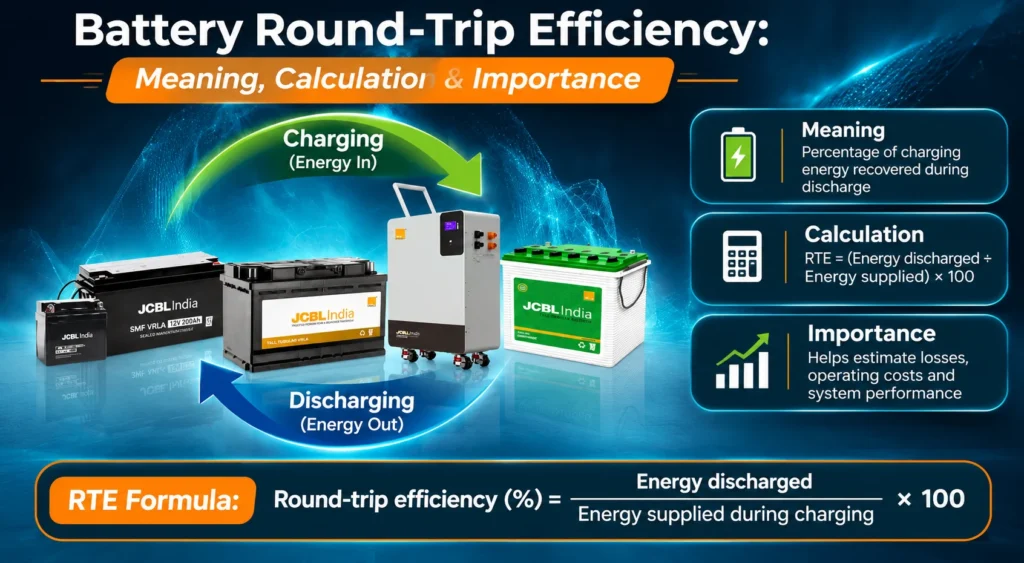
Battery round-trip efficiency (RTE) measures the percentage of energy supplied to a battery during charging that is recovered as useful electrical energy during discharge. It is calculated by dividing discharged energy by charging energy and multiplying by 100.
For example, a battery energy storage system (BESS) that receives 100 kWh and returns 90 kWh has a round-trip efficiency of 90%, provided both measurements use the same system boundary.
For businesses evaluating battery storage, RTE helps quantify energy losses, estimate operating costs, and compare system performance. However, an efficiency percentage is meaningful only when the measurement method and operating conditions are clearly defined.
How to Calculate Battery Round-Trip Efficiency
The battery round-trip efficiency formula is:
Round-trip efficiency (%) = (Energy discharged ÷ Energy supplied during charging) × 100
Here, energy discharged is the useful electrical energy recovered from the system, while energy supplied during charging is the electrical energy used to charge it. Both values must use the same unit, such as kilowatt-hours (kWh) or megawatt-hours (MWh), and refer to consistent measurement boundaries.
Battery Round-Trip Efficiency Calculation Example
Consider a BESS with the following energy readings:
Energy supplied during charging: 100 kWh
Energy delivered during discharge: 90 kWh
Applying the formula:
RTE = (90 ÷ 100) × 100 = 90%
The system returns 90 kWh for every 100 kWh supplied during charging. The remaining 10 kWh is not recovered as useful electrical output within the defined measurement boundary.
The same calculation applies to larger installations. If a commercial battery storage system receives 1,000 kWh and returns 850 kWh, its RTE is 85%.
These examples illustrate the formula. Actual system efficiency depends on battery characteristics, conversion equipment, auxiliary consumption, and operating conditions.
How Is Round-Trip Efficiency Measured in a BESS?
For a real battery energy storage system, efficiency is assessed using metered energy input and output over a defined measurement period. The U.S. Department of Energy’s Federal Energy Management Program describes a methodology for evaluating deployed BESS performance using actual charging and discharging data.
Reliable measurements require:
- Defined energy metering points.
- Consistent charging and discharging boundaries.
- Recorded charging and discharging energy over a representative period.
- Consideration of initial and final state of charge.
- Clear treatment of auxiliary loads and standby consumption.
For systems that do not complete a full charge–discharge cycle every day, a longer analysis period may be needed to produce a representative estimate.
AC-to-AC vs. DC-to-DC Round-Trip Efficiency
The measurement boundary determines which energy losses are reflected in a reported RTE.
| Metric | Measurement point | Key consideration |
|---|---|---|
| DC-to-DC efficiency | Defined DC input and output points | Reflects losses within the components included between those points |
| AC-to-AC efficiency | Defined AC input and output points | Can include inverter, auxiliary and other system losses |
DC-to-DC efficiency is useful for assessing battery-side performance. AC-to-AC efficiency is often more relevant to grid-connected storage projects because it measures energy entering and leaving the system on the AC side.
However, the precise losses included depend on system configuration and test methodology. Two vendors may report different efficiency values because they use different measurement boundaries or operating conditions, rather than because one battery is inherently better.
What Is a Good Battery Round-Trip Efficiency?
A good battery round-trip efficiency depends on the technology, system configuration, application, and measurement method.
For context, the National Renewable Energy Laboratory’s 2021 Annual Technology Baseline adopted 86% as a representative round-trip efficiency assumption for its modelled battery storage systems. This is a historical modelling assumption, not a universal benchmark or a guarantee of actual performance.
When comparing systems, evaluate:
- System-level performance: Check complete-system efficiency rather than relying exclusively on cell specifications.
- Operating conditions: Review the temperature, charging power, discharging power, and state-of-charge window used for testing.
- Auxiliary energy: Determine whether cooling, heating, and standby consumption are included.
- Application requirements: Consider whether the system will cycle daily, provide backup power, or support renewable energy integration.
A higher RTE generally means less energy is lost during charging and discharging. Nevertheless, efficiency should be evaluated alongside usable capacity, power rating, cycle life, degradation, availability, and total project cost.
What Factors Affect Battery Round-Trip Efficiency?
Several factors influence the proportion of charging energy recovered during discharge.
1. Battery Chemistry and Internal Resistance
Different battery chemistries and cell designs have different electrochemical characteristics and internal resistance. These influence heat generation and energy losses during charging and discharging. Battery chemistry alone, however, does not determine complete-system efficiency.
2. Charging and Discharging Power
Operating a battery at different power levels can change resistive losses and heat generation. Efficiency specifications should therefore reflect the charging and discharging rates expected in the intended application.
3. Operating Temperature
Temperature affects battery performance and may increase the electricity required for thermal management. In hot climates, including parts of India, cooling demand can be an important consideration when estimating net AC-to-AC efficiency.
4. Power Conversion Losses
Grid-connected battery systems typically use inverters or power conversion systems to convert electricity between AC and DC. These conversions introduce losses that can reduce overall system efficiency relative to battery-side measurements.
5. Auxiliary Loads and Standby Consumption
Heating, ventilation, air conditioning, control systems, and other auxiliary equipment consume electricity. Whether these loads affect the reported RTE depends on the measurement boundary.
For facility operators and utilities, understanding net energy delivered at the relevant connection point is particularly important when estimating usable output.
6. State of Charge and Battery Degradation
The tested state-of-charge range and battery condition can influence measured performance. As batteries age, usable capacity generally declines, while round-trip efficiency may also change. These are separate performance measures and should not be treated as interchangeable.
Why Is Battery Round-Trip Efficiency Important?
Round-trip efficiency affects energy delivery, operating costs and the financial performance of battery storage projects.
Energy Losses and Usable Output
A lower RTE means less electricity is returned for the same amount of charging energy. Facilities must account for these losses when estimating how much electricity a BESS can supply during peak demand or other operating periods.
Operating Costs and Energy Price Arbitrage
Consider a BESS operating at 90% RTE that must deliver 90 kWh. Under the simplified formula, it requires 100 kWh of charging energy.
Charging electricity: 100 kWh
Electricity tariff: ₹5 per kWh
Charging energy cost: ₹500
This excludes demand charges, maintenance, financing, and other operating costs.
For businesses shifting electricity consumption away from expensive tariff periods, RTE helps determine the charging energy required and the potential economic benefit. Actual savings depend on tariff structures, operating schedules, availability, and degradation.
Renewable Energy Utilisation
Solar and wind generation may exceed demand at certain times. A battery can store surplus electricity for later use, but some energy is lost during the storage cycle.
RTE helps estimate how much stored renewable electricity can be recovered. System configuration also matters: AC-coupled and DC-coupled solar-plus-storage installations can have different conversion pathways and associated losses.
BESS Project Economics
For developers, utilities and commercial energy users, RTE is an important input in financial models. It affects energy throughput, charging requirements and potential revenue from storage services.
However, it cannot determine project viability on its own. Capital expenditure, electricity prices, battery degradation, maintenance, financing and expected revenue must also be considered.
Battery Round-Trip Efficiency vs. Other Performance Metrics
Battery round-trip efficiency measures energy recovery, while other metrics describe different aspects of system performance.
| Metric | What it measures |
|---|---|
| Round-trip efficiency | Percentage of charging energy recovered as useful output |
| Energy capacity | Amount of energy stored or delivered under specified conditions |
| Power rating | Rate at which the system can charge or discharge |
| Depth of discharge (DoD) | Proportion of available battery capacity used |
| State of charge (SoC) | Remaining charge relative to the defined capacity |
| Cycle life | Number of charge–discharge cycles achievable under specified conditions |
These metrics should be evaluated together. A system with high RTE may still be unsuitable if its capacity, discharge duration or power rating does not meet the project’s requirements.
How to Evaluate Battery Round-Trip Efficiency When Selecting a BESS
For BESS procurement teams, comparing quoted efficiency percentages is not enough. Use the following checklist to assess supplier proposals:
- Verify the efficiency rating: Establish whether the figure is AC-to-AC or DC-to-DC.
- Confirm measurement boundaries: Identify exactly where charging and discharged energy are measured.
- Review auxiliary consumption: Check whether HVAC, standby loads and other electrical consumption are included.
- Validate test conditions: Compare operating temperature, power levels, and state-of-charge limits.
- Examine performance guarantees: Review guaranteed efficiency, test procedures, exclusions, and applicable operating conditions.
- Assess long-term performance: Consider degradation and expected efficiency over the project lifetime.
- Request supporting evidence: Examine technical datasheets, independent test reports, and documented performance data.
For commercial and industrial installations, prioritize guaranteed net AC-to-AC efficiency under operating conditions representative of the project. This creates a more meaningful basis for comparing suppliers than relying on battery-cell efficiency alone.
For projects in India, also account for local ambient temperatures, site-specific cooling requirements, electricity tariffs, and applicable grid requirements when modelling expected performance.
Conclusion
Battery round-trip efficiency measures how much of the energy supplied during charging is recovered as useful electrical output. Its calculation is straightforward, but interpreting the result requires a clear measurement boundary and consistent operating conditions.
For BESS developers, operators, and procurement teams, the most useful assessment combines verified system-level efficiency with capacity, power, degradation, and project economics. Comparing these factors under realistic operating conditions provides a stronger basis for technical evaluation and investment decisions.
Frequently Asked Questions (FAQs)
1. Why is battery round-trip efficiency less than 100%?
Energy is lost through internal resistance, heat generation, power conversion, and auxiliary consumption. The amount of energy lost depends on the battery, system configuration, operating conditions, and measurement boundary.
2. Does higher round-trip efficiency mean a better battery?
Not necessarily. Higher RTE means less energy is lost during the measured charge–discharge process, but battery selection also depends on capacity, power rating, cycle life, degradation, safety, reliability and project cost.
3. Does battery round-trip efficiency decrease over time?
It can change as the battery ages, but the extent depends on the technology, operating conditions and system components. Capacity degradation and efficiency degradation are different metrics and should be evaluated separately.
4. How does round-trip efficiency affect BESS operating costs?
Lower RTE increases the charging energy needed to deliver a given quantity of electricity. This can increase energy costs, especially in applications involving frequent cycling with purchased electricity.