

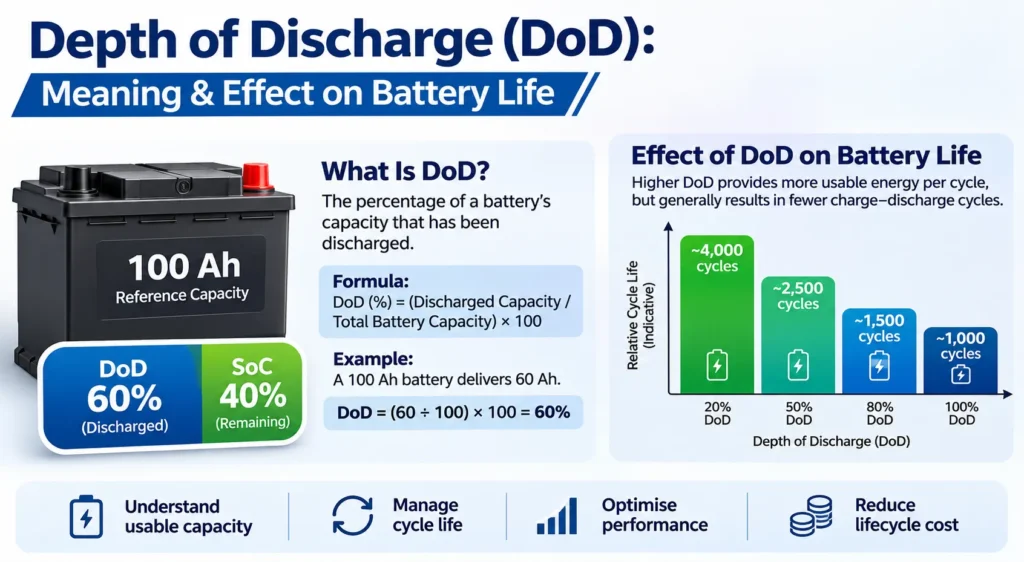
Depth of Discharge (DoD) is the percentage of a battery’s reference capacity that has been discharged. For example, discharging 60 Ah from a 100 Ah battery represents a 60% DoD, leaving approximately 40% State of Charge (SoC) under the same capacity reference. A higher DoD generally provides more usable energy per cycle but can reduce battery cycle life. The extent of this effect depends on battery chemistry, temperature, discharge rate, and operating conditions.
For businesses using batteries in energy storage, industrial equipment, or backup power systems, understanding DoD helps determine usable capacity, operating limits, and long-term battery costs.
How Is Depth of Discharge (DoD) Calculated?
Battery DoD is calculated by dividing the capacity discharged by the reference capacity and multiplying the result by 100.
Formula: DoD (%) = (Discharged Capacity / Total Battery Capacity) × 100
Example: A 100 Ah battery delivers 60 Ah during discharge.
DoD = (60 Ah ÷ 100 Ah) × 100 = 60%
The battery has approximately 40% SoC remaining, assuming the same capacity reference and negligible measurement differences.
What Is the Difference Between DoD and SoC?
Depth of Discharge measures the proportion of battery capacity used, while State of Charge measures the proportion remaining.
| Depth of Discharge (DoD) | State of Charge (SoC) |
|---|---|
| 20% discharged | Approximately 80% charged |
| 50% discharged | Approximately 50% charged |
| 80% discharged | Approximately 20% charged |
Under a consistent capacity reference, DoD and SoC approximately add up to 100%. Actual battery-management-system readings may vary because of estimation methods, capacity degradation, and measurement tolerances.
How Does Depth of Discharge Affect Battery Life?
Depth of Discharge affects how many charge-discharge cycles a battery can complete before reaching its specified end-of-life threshold. For many rechargeable batteries, deeper discharge cycles generally result in fewer cycles than shallower discharge cycles.
This happens because battery degradation depends partly on the depth of cycling. However, the relationship varies by chemistry, cell design, temperature, discharge rate, and charging conditions.
For example, a battery that is regularly discharged to 80% DoD may provide more energy per cycle than one discharged to 50% DoD, but it may complete fewer cycles over its service life. The actual difference must be established using cycle-life data for the specific battery model.
Businesses should therefore evaluate both usable energy per cycle and expected lifetime energy throughput instead of comparing cycle counts alone.
DoD vs. Battery Cycle Life: What Does the Data Show?
Battery cycle life generally decreases as DoD increases, but the relationship is product-specific. Manufacturer data illustrates this variation.
For example, NPP Power India’s LFP battery product information publishes cycle-life figures for different DoD levels. Such figures should be interpreted in the context of the applicable battery model, test conditions, and end-of-life criteria.
When comparing cycle-life specifications, verify:
- Battery chemistry and model: Different cells and battery designs can have different degradation characteristics.
- Test conditions: Temperature, charge-discharge rate, and charging limits influence cycle life.
- End-of-life criterion: The remaining capacity at which cycle testing ends affects the reported result.
Do not use cycle-life figures from different battery models as a direct comparison unless their test conditions are sufficiently comparable.
What Is the Recommended DoD for Different Battery Types?
The recommended DoD depends on the battery’s chemistry, design, manufacturer specifications, and required service life. There is no universal DoD limit for every battery.
1. Lithium-Ion Batteries
Lithium-ion batteries: The permissible DoD varies by chemistry and model. Follow the manufacturer’s specified operating limits and cycle-life recommendations.
2. LiFePO₄ Batteries
Many lithium iron phosphate batteries support relatively deep discharge, with some models rated for operation at 80–100% DoD. Maximum permitted DoD does not necessarily provide maximum cycle life.
3. Lead-Acid Batteries
Lead-acid batteries: These batteries generally benefit from shallower discharge cycles. The appropriate limit depends on battery design, such as flooded, AGM, or gel, and the manufacturer’s recommendations.
For industrial and commercial applications, use the specified DoD and cycle-life curves for the actual battery model rather than relying on a generic percentage.
How Can You Optimise DoD to Extend Battery Life?
Businesses can manage DoD to balance available energy with battery longevity.
1. Configure Discharge Limits
Set the battery management system (BMS) or controller according to the manufacturer’s voltage and discharge specifications.
2. Size the Battery Appropriately
Select sufficient capacity to meet energy demand without routinely exceeding the intended DoD.
3. Monitor Operating Conditions
Track DoD, SoC, temperature, and discharge current to identify operating patterns that may accelerate degradation.
4. Follow Charging Specifications
Use compatible charging equipment and manufacturer-approved charging parameters.
5. Evaluate Lifecycle Costs
Compare usable energy, expected lifetime throughput, replacement frequency, warranty terms, and total cost of ownership.
For B2B buyers, the objective is not simply to maximise usable capacity per cycle. It is to achieve the required energy output and reliability at an acceptable lifecycle cost.
Conclusion
Depth of Discharge determines how much of a battery’s reference capacity is used during discharge and influences its cycle life. Higher DoD generally provides more energy per cycle, while shallower cycling can extend battery service life. For commercial and industrial applications, the right DoD depends on the battery model, usable energy requirements, operating conditions, and expected lifetime cost.
Frequently Asked Questions (FAQs)
1. What does 80% DoD mean?
An 80% DoD means that 80% of the battery’s reference capacity has been discharged, leaving approximately 20% SoC. The remaining usable energy depends on the battery’s actual condition and operating limits.
2. Is a lower DoD better for battery life?
Generally, shallower discharge cycles allow more cycles before a battery reaches its specified end-of-life threshold. The improvement depends on battery chemistry, design, and operating conditions.
3. Does 100% DoD damage a battery?
Not necessarily. Some batteries are designed to support 100% DoD within their specified operating limits. However, repeatedly using the full rated capacity may reduce cycle life compared with shallower cycling.
4. How does DoD affect lithium-ion battery cycle life?
For many lithium-ion batteries, deeper discharge cycles are associated with fewer cycles before reaching the specified end-of-life threshold. The extent of the effect depends on cell chemistry, temperature, charge-discharge rate, and battery design.
5. How should businesses choose the right DoD?
Businesses should assess energy demand, battery chemistry, manufacturer-rated cycle life, operating conditions, and lifecycle cost. The selected DoD should meet application requirements without exceeding the battery’s specified operating limits.