

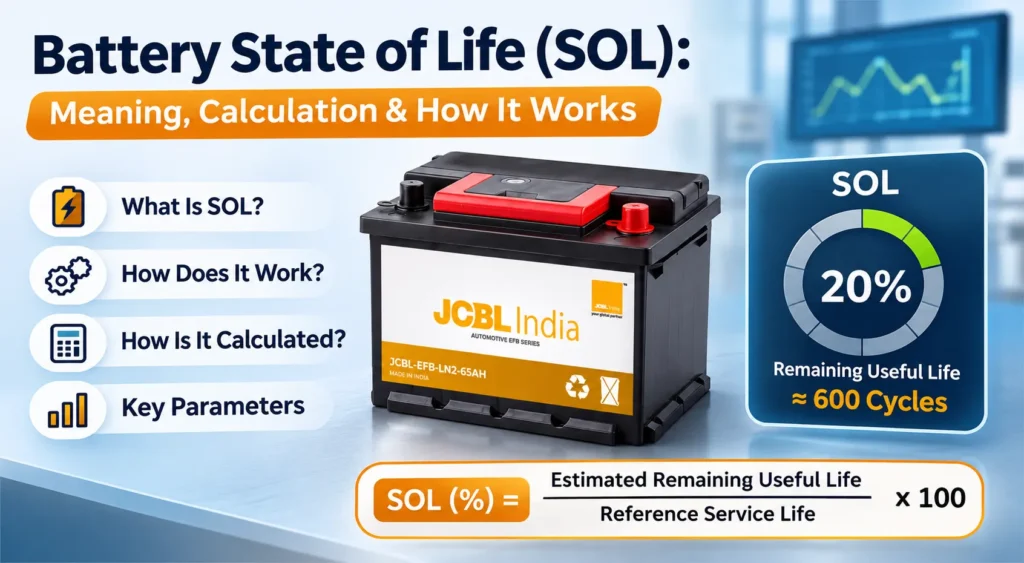
A battery’s performance changes as it undergoes repeated charge-discharge cycles and exposure to operating conditions. Battery State of Life (SOL) describes how much of its useful service life remains before it reaches its defined end-of-life condition. It helps battery manufacturers, electric vehicle (EV) operators, and energy storage companies assess battery longevity, plan maintenance, and make informed replacement decisions.
But how is SOL determined, and which battery parameters influence it? Understanding its estimation process helps businesses manage battery assets more effectively.
What Is Battery State of Life (SOL)?
Battery State of Life (SOL) is an indicator of a battery’s estimated remaining useful service life before it reaches its defined end-of-life (EOL) condition. It can be expressed as the remaining number of charge-discharge cycles, operating hours, or a percentage of its expected service life.
As a battery ages, its ability to store and deliver energy gradually changes. SOL estimation uses this degradation information to assess how much operational life remains.
Example of Battery SOL
If a battery is expected to provide 3,000 cycles under specified operating conditions and its estimated remaining life is 600 cycles, it has approximately 600 usable cycles remaining under those assumptions.
SOL terminology can vary between technical applications. Remaining Useful Life (RUL) is the more established term in battery prognostics for expressing the predicted time or cycles remaining before a defined end-of-life threshold is reached.
How Does Battery State of Life Work?
SOL works by evaluating battery degradation data and estimating how long the battery can continue operating before reaching its specified end-of-life limit.
The estimation process generally involves four steps:
1. Data Collection
The Battery Management System (BMS) records operating parameters such as voltage, current, temperature, and charge-discharge activity.
2. Degradation Assessment
Changes in battery capacity, internal resistance, and operating behavior are evaluated to identify aging patterns.
3. Life Estimation
Mathematical models or data-driven algorithms analyze historical and current battery data to predict future degradation.
4. Remaining Life Prediction
The estimated degradation trend is used to calculate the remaining cycles or operating time before the battery reaches its defined EOL condition.
The accuracy of this prediction depends on the quality of operational data, the battery chemistry, the estimation model, and future usage conditions.
How Is Battery State of Life (SOL) Calculated?
Battery SOL is estimated using battery degradation indicators and a defined end-of-life threshold. There is no single universal formula for calculating SOL across all battery chemistries and applications.
A common approach is to estimate Remaining Useful Life (RUL) in cycles or operating time.
For a cycle-based estimate:
RUL = Predicted cycles at EOL − Cycles already completed
If SOL is represented as a normalized percentage of expected service life, an illustrative calculation is:
SOL (%) = (Estimated remaining useful life ÷ Reference service life) × 100
For example:
Reference service life: 3,000 cycles
Estimated remaining useful life: 600 cycles
Calculation: SOL = (600 ÷ 3,000) × 100 = 20%
This means the battery has an estimated 20% of its reference service life remaining under the assumed operating conditions.
This percentage is an illustrative normalized life indicator, not a universally prescribed SOL calculation. Actual RUL estimation requires a validated degradation model and an application-specific EOL criterion.
Parameters Used for SOL Estimation
Several battery parameters help determine degradation and predict remaining life:
1. Capacity Retention
Measures how much charge the battery can store compared with its original or reference capacity. Capacity retention testing helps evaluate changes in available battery capacity.
2. Internal Resistance
Tracks resistance changes that can affect power delivery and heat generation.
3. Charge-Discharge Cycles
Records battery cycling activity and cumulative usage.
4. Operating Temperature
Helps identify thermal conditions that influence battery aging.
5. Voltage and Current Profiles
Reveal charging, discharging, and load behavior.
6. Depth of Discharge (DoD)
Indicates how much of the battery’s available capacity is used during each discharge cycle. Learn more about Depth of Discharge (DoD).
These parameters are evaluated together because no single measurement can reliably describe every aspect of battery degradation.
What Factors Affect Battery State of Life?
The battery state of life is influenced by electrochemical aging and operating conditions. The main factors include:
1. Charge-Discharge Cycles
Repeated cycling contributes to gradual capacity loss and resistance growth. Charging and discharging cycles influence the rate of battery degradation.
2. Depth of Discharge
Frequent deep discharge can accelerate degradation in many lithium-ion battery applications.
3. Temperature
Sustained exposure to high temperatures can accelerate aging, while low temperatures can affect performance and charging behavior.
4. Charging and Discharging Rates
High current loads can increase heat generation and influence degradation.
5. Calendar Aging
Batteries can deteriorate over time even when they are not actively cycled.
6. Operating Conditions
Storage conditions, charging practices, and load profiles influence the rate of battery aging.
The impact of these factors varies with battery chemistry, design and operating requirements.
SOL vs SOH vs SOC: What Is the Difference?
SOL, SOH and SOC describe different aspects of battery operation. Understanding their differences is important for accurate battery monitoring and lifecycle assessment.
| Parameter | What It Measures | Primary Purpose |
|---|---|---|
| SOL (State of Life) | Estimated remaining useful service life | Lifecycle planning |
| SOH (State of Health) | Current condition relative to a reference or new battery | Degradation assessment |
| SOC (State of Charge) | Remaining charge relative to available battery capacity | Real-time charge monitoring |
For example, SOC indicates how much charge is available now, SOH describes how the battery has degraded, and SOL estimates how much useful operating life remains.
SOH is commonly estimated using capacity retention or resistance-related indicators. SOC is estimated using methods such as Coulomb counting, voltage-based approaches, and battery models. SOL/RUL estimation uses degradation trends to predict future battery life.
Why Is Battery State of Life Important for Businesses?
SOL estimation supports practical decisions across battery-powered industries, particularly electric mobility and stationary energy storage.
1. Battery Lifecycle Management
Helps estimate when batteries may approach their operational end-of-life.
2. Predictive Maintenance
Supports maintenance planning based on estimated degradation rather than fixed service intervals alone.
3. Replacement Planning
Helps operators assess when battery replacement may be necessary.
4. Fleet Management
Allows EV fleet operators to monitor battery ageing and plan vehicle availability.
5. Energy Storage Management
Helps battery energy storage system (BESS) operators assess asset longevity and plan maintenance.
6. Second-Life Assessment
Supports preliminary evaluation of retired EV batteries for potential reuse, subject to capacity, safety, and application-specific testing.
For manufacturers and operators, SOL estimation provides an additional input for asset planning, operational reliability, and lifecycle cost management.
How Is SOL Used in a Battery Management System (BMS)?
A battery management system uses battery measurements and estimation algorithms to monitor operating conditions and assess battery performance. While SOC and SOH are established BMS estimation functions, SOL or RUL prediction may require additional prognostic models.
Depending on the BMS architecture, SOL estimation can support:
- Tracking battery degradation over time.
- Estimating remaining charge-discharge cycles.
- Identifying trends in capacity loss and resistance growth.
- Supporting maintenance and replacement schedules.
- Assessing battery performance against defined operational requirements.
For more reliable predictions, BMS-based estimation should account for battery chemistry, operating history, model limitations, and changing usage conditions.
Conclusion
Battery State of Life provides an estimate of how much useful operating life remains before a battery reaches its defined end-of-life condition. By combining degradation indicators, operating data, and predictive models, businesses can make better-informed decisions about battery maintenance, replacement, and asset management.
For battery manufacturers, EV operators, and energy storage businesses, reliable SOL estimation is an important part of long-term battery lifecycle planning. Its value depends on accurate monitoring, validated prediction models, and clearly defined end-of-life criteria.
Disclaimer: Battery SOL estimates are predictive and depend on battery chemistry, operating conditions, data quality, and the selected end-of-life criteria. They should not be treated as a standalone measure of battery safety or a substitute for technical inspection and validation.
Frequently Asked Questions (FAQs)
1. What does SOL mean in a battery?
SOL stands for State of Life. It indicates the estimated remaining useful service life of a battery before it reaches its defined end-of-life condition.
2. How is battery SOL measured?
Battery SOL can be expressed as estimated remaining cycles, operating hours or a normalized percentage of reference service life. Its estimation uses degradation data and predictive models.
3. Is SOL the same as SOH?
No. SOH describes a battery’s present condition relative to a reference condition, while SOL estimates its remaining useful operating life.
4. What is the difference between SOL and RUL?
SOL is used in some applications as an indicator of remaining battery life. RUL (Remaining Useful Life) is the established prognostic term for the predicted cycles or operating time before a defined end-of-life threshold.
5. Can a BMS estimate battery SOL?
Yes. A BMS can support SOL estimation when it incorporates suitable degradation monitoring and life-prediction algorithms alongside its standard battery monitoring functions.
6. When does a battery reach its end of life?
A battery reaches end of life when it no longer meets the capacity, power, safety, or performance requirements defined for its application. The threshold is not identical across all battery types and applications.