

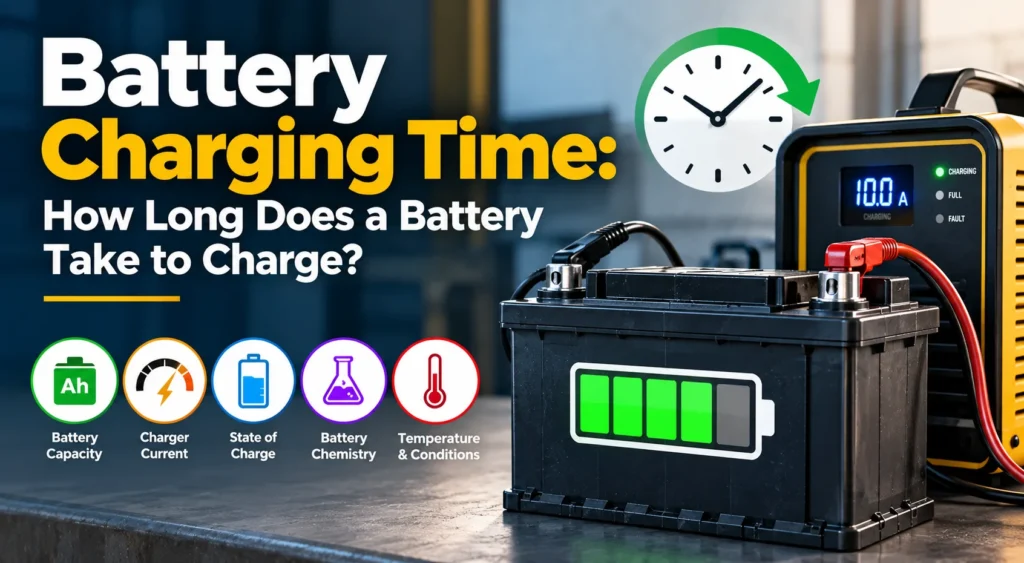
Battery charging time depends on its capacity, state of charge, charger output current, battery chemistry, and charging profile. A battery’s charging time can be estimated by dividing the amp-hours that need replenishing by the charging current. However, the actual time to reach a full charge will vary because of charging losses and the battery’s charging characteristics.
How Long Does a Battery Take to Charge?
A battery can take a few hours to more than a day to charge, depending on its capacity, initial state of charge, charger current, and chemistry. A smaller battery with a higher compatible charging current generally charges faster than a larger battery under comparable conditions. Lead-acid batteries may require additional time during the absorption stage to reach a full charge.
How to Calculate Battery Charging Time
Use this formula to estimate battery charging time:
Battery charging time (hours) ≈ Capacity to replenish (Ah) ÷ Charging current (A)
Capacity to replenish is the amount of charge the battery needs, measured in amp-hours (Ah). Charging current is the current supplied to the battery, measured in amperes (A).
Battery Charging Time Calculation Example
Consider a 100Ah battery at 50% state of charge connected to a compatible 10A charger.
- Battery capacity: 100Ah
- Initial state of charge: 50%
- Capacity to replenish: 50Ah
- Charger output current: 10A
Estimated charging time = 50Ah ÷ 10A = 5 hours
This is an idealized estimate of the time required to replenish 50Ah at a constant 10A. Actual full-charge time will be longer if the charging current decreases, charging losses occur, or the battery requires additional charging stages.
Estimated Battery Charging Times
The following table shows idealized charging times at a constant current, assuming the battery needs to replenish the stated capacity.
| Capacity to replenish | Charging current | Idealized time |
| 25Ah | 5A | 5 hours |
| 50Ah | 10A | 5 hours |
| 80Ah | 20A | 4 hours |
| 100Ah | 10A | 10 hours |
These figures are mathematical estimates, not guaranteed full-charge times. The actual duration depends on the battery’s chemistry, charging efficiency, current tapering, temperature, and charger configuration.
What Factors Affect Battery Charging Time?
Five main factors determine how long a battery takes to charge.
- Battery capacity: A battery with a higher Ah rating generally requires more time to recharge than a smaller battery when the charging current and initial state of charge are comparable.
- State of charge: A battery at 20% state of charge needs more charge replenished than the same battery at 70% state of charge.
- Charger output current: A compatible charger delivering 20A can replenish charge faster than one delivering 10A, provided the battery can safely accept the higher current.
- Battery chemistry: Lead-acid and lithium-ion batteries have different charging characteristics, which affect how quickly they accept charge and reach full capacity.
- Temperature and charging conditions: Battery temperature, charger efficiency, cable losses, and current restrictions can affect charging duration. A battery management system may limit charging current to keep the battery within its permitted operating conditions.
Does Battery Type Affect Charging Time?
Yes. Battery chemistry determines the charging profile and influences the time required to reach full charge.
Lead-Acid Battery Charging Time
Lead-acid batteries typically use bulk, absorption, and, where applicable, float charging stages.
During bulk charging, the battery receives most of the required charge. During absorption, the charging voltage is maintained while the current gradually decreases, allowing the battery to approach full charge. This stage can significantly extend the total charging time, especially when the battery is deeply discharged.
For example, Victron Energy’s published guidance describes a charging scenario in which a fully discharged 100Ah lead-acid battery takes approximately 16 hours to recharge using a 10A charger under the stated assumptions. The estimate includes bulk and absorption charging. Actual charging time varies with the battery, charger, and operating conditions.
Lithium-Ion Battery Charging Time
Lithium-ion battery charging time depends on the battery’s capacity, specific chemistry, permitted charging current, temperature, and battery management system.
Lithium-ion batteries use charging profiles that differ from those of lead-acid batteries. Some can accept relatively high charging currents, but the permissible rate depends on the battery design and manufacturer‘s specifications. Therefore, batteries with the same Ah rating can have different charging times.
Why Does a Battery Take Longer to Charge Than Expected?
If a battery takes longer to charge than the calculated estimate, consider these possible causes:
- Lower charging current: The charger may deliver less current than expected under the existing conditions.
- Deep discharge: A battery with a lower initial state of charge needs more charge replenished.
- Current tapering: Charging current decreases during the final stage of charging, particularly with lead-acid batteries.
- Temperature restrictions: The charger or battery management system may reduce or suspend charging.
- Battery degradation: An aged or damaged battery may exhibit abnormal charging behaviour.
Check the battery and charger specifications to confirm compatibility. If charging remains unusually slow, have the battery and charging system assessed according to the manufacturer’s guidance.
Conclusion
Battery charging time depends on the capacity that needs replenishing, the charging current the battery can accept, and its chemistry-specific charging profile. The capacity-to-current formula provides a useful estimate, but the actual time to full charge depends on charging losses and the final charging stages.
For businesses selecting batteries for automotive, industrial, and backup-power applications, matching battery specifications with a compatible charging system is essential for predictable performance. Consult the manufacturer’s technical documentation to determine the appropriate charging requirements for your application.
FAQs
A 12V battery may take a few hours or longer to charge, depending on its capacity, initial state of charge, charger current, and chemistry. Voltage alone cannot determine charging time; the battery’s Ah rating and charging specifications are also needed.
If a 100Ah battery is at 50% state of charge, it needs approximately 50Ah replenished. A compatible 10A charger gives an idealized estimate of five hours. Actual time to full charge depends on the charging profile, losses, and battery chemistry.
Generally, yes. A charger with a higher output current can reduce charging time if the battery is designed to accept that current. Always follow the battery manufacturer’s charging-current limits.
During the absorption stage of lead-acid charging, current gradually decreases as the battery approaches full charge. As a result, the final portion of charging can take disproportionately longer than the initial bulk stage.
Follow the manufacturer’s full-charge criteria and the charger’s completion indicators. Depending on the battery, these may include specified voltage, charging current, or charging-stage conditions. Voltage alone may not always confirm a full charge.