

A Battery Request for Quotation (RFQ) should give a supplier enough information to understand exactly what the buyer needs, how the battery will be used, and what must be delivered. A vague RFQ may produce a quick price, but it can also lead to mismatched specifications, repeated clarification, unexpected tooling costs, or compliance issues later.
For B2B buyers, the objective is therefore not simply to ask for a battery price. A good battery RFQ defines the technical specification, application requirements, quantity, compliance expectations, customization, and commercial terms clearly enough for suppliers to prepare a meaningful quotation.
What Is a Battery RFQ?
A battery RFQ is a formal request asking a supplier to quote for a specific battery or battery pack based on defined requirements.
It is different from a general product inquiry. An inquiry might ask whether a supplier manufactures a particular type of battery. An RFQ goes further by providing the information needed to determine the product configuration, production requirements, testing, documentation, pricing, and delivery terms.
The more clearly the requirement is defined, the less room there is for suppliers to make different assumptions when preparing their quotations.
What Information Should Be Included in a Battery RFQ?
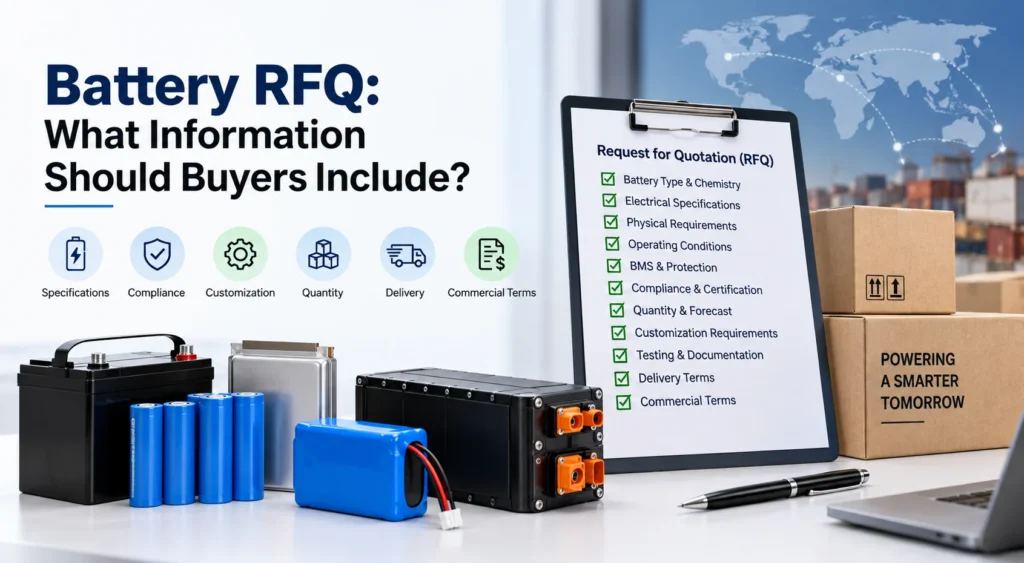
A battery RFQ should include the battery type and chemistry, electrical specifications, physical requirements, operating conditions, BMS, compliance requirements, quantity, customization, testing, delivery, and commercial terms. The level of detail will depend on whether you are sourcing a standard battery or a custom battery pack.
1. Battery Type and Chemistry
Start by stating exactly what you want suppliers to quote. Specify the battery chemistry, configuration, and format, such as lithium-ion, LiFePO₄, NiMH, or lead-acid, and whether you need cells, modules, or a complete pack.
If you already require a specific cell format or pack configuration, include it. Chemistry and configuration can significantly affect performance, safety requirements, and cost.
2. Electrical Specifications
Provide the electrical parameters that define how the battery must perform. At minimum, specify nominal voltage and capacity. Depending on the application, also include the voltage range, continuous and peak discharge current, charging voltage and current, energy requirement, and cycle-life target.
Avoid specifying capacity alone. A requirement such as “100 Ah battery” is incomplete without the corresponding voltage and application requirements.
3. Physical and Mechanical Requirements
State the maximum dimensions, weight, connector or terminal type, cable configuration, and mounting requirements.
If the battery must fit an existing product or enclosure, provide firm dimensional limits and, where possible, a mechanical drawing or reference design. This helps prevent quotations for batteries that meet the electrical requirements but cannot physically integrate into the application.
4. Operating Conditions
Describe the conditions under which the battery will be used. Relevant information may include operating and storage temperatures, expected runtime, load profile, cycle frequency, and environmental conditions.
These requirements help suppliers select or configure a battery based on actual application needs rather than nominal voltage and capacity alone.
5. BMS and Protection Requirements
For rechargeable packs, specify whether a Battery Management System (BMS) is required and identify any necessary protection or communication functions.
Depending on the application, this may include cell balancing, overcharge or over-discharge protection, overcurrent and temperature protection, or communication protocols such as CAN, UART, SMBus, or RS485.
Also clarify whether a standard BMS is acceptable or a customized system is required, as this can affect engineering and tooling costs.
6. Compliance and Certification Requirements
Identify the standards, certifications, test reports, and transport documentation required for the battery, application, and destination market.
Depending on the product and market, requirements may include UN 38.3 for applicable lithium batteries, relevant IEC standards, UL requirements, or environmental regulations such as RoHS and REACH.
Instead of stating “all certifications required,” specify the actual requirements and ask suppliers to identify any additional testing or documentation costs separately.
7. Quantity and Forecast
State the sample quantity, initial order quantity, and expected recurring volume. Include an annual forecast if available.
Separating sample requirements from production volumes helps suppliers determine appropriate pricing, MOQ, production capacity, and customization costs.
8. Customization Requirements
Clearly identify any requirements beyond a standard battery configuration, including custom dimensions, housing, connectors, cables, labeling, branding, BMS, communication interfaces, or packaging.
For custom packs, ask suppliers to quote recurring unit costs separately from one-time tooling, engineering, or NRE charges. This makes competing quotations easier to evaluate.
9. Testing and Quality Requirements
Define what testing and quality documentation the supplier must provide. Depending on the application, this could include capacity testing, electrical checks, safety testing, cycle-life testing, inspection reports, or batch traceability.
Avoid vague requirements such as “premium quality.” If specific acceptance criteria or inspection procedures apply, include them in the RFQ or attach them as a separate quality specification.
10. Delivery and Commercial Terms
Finally, specify the delivery destination, required date, Incoterm, payment terms, warranty, MOQ, lead time, quote validity, and packaging costs.
For applicable batteries, include relevant dangerous-goods shipping and documentation requirements. Ask suppliers to separate unit pricing from tooling, testing, packaging, and other additional charges so that quotations can be compared on the same basis.
Battery RFQ Checklist
Before sending the RFQ, buyers should confirm that the document clearly covers:
- Battery chemistry and configuration
- Voltage, capacity, and current requirements
- Dimensions, weight, and connections
- Operating conditions
- BMS and protection requirements
- Applicable certifications and documentation
- Sample and production quantities
- Customization requirements
- Testing and quality expectations
- Packaging and shipping
- Delivery destination and schedule
- Price, MOQ, lead time, Incoterm, payment terms, and warranty
The purpose of this checklist is not to make every RFQ longer. It is to make sure that information capable of changing the supplier’s product configuration or quotation has not been overlooked.
Simple Battery RFQ Template
A practical RFQ can use a format such as:
| Requirement | Buyer Specification |
| Battery type & chemistry | |
| Voltage & capacity | |
| Discharge/charging requirements | |
| Dimensions & weight | |
| Connector/terminal | |
| Operating conditions | |
| BMS requirements | |
| Certifications | |
| Testing requirements | |
| Sample quantity | |
| Production quantity | |
| Forecast | |
| Customization | |
| Packaging | |
| Delivery destination/date | |
| Incoterm | |
| Payment terms | |
| Warranty |
Suppliers can then return their quotation against the same fields, making technical and commercial comparisons much easier.
Common Battery RFQ Mistakes
The most common battery RFQ mistakes are incomplete specifications, vague customization requirements, unclear compliance needs, and inconsistent commercial terms. These gaps can lead to inaccurate quotations, repeated clarification, or unexpected costs after an order is placed.
Buyers should avoid these common mistakes:
- Specifying capacity without voltage: A requirement such as “100 Ah battery” is incomplete without the required voltage and application conditions.
- Using vague customization terms: Writing “custom battery” without defining dimensions, connectors, housing, BMS, or other modifications leaves too much room for interpretation.
- Leaving compliance requirements unclear: Instead of asking for “all certifications,” identify the applicable standards, reports, or transport documentation required for the target market.
- Comparing quotations with different assumptions: Suppliers should receive the same quantity, Incoterm, delivery destination, testing requirements, and packaging expectations.
- Ignoring one-time costs: Tooling, engineering, testing, and certification charges should be identified separately from the recurring battery unit price.
- Providing no volume forecast: Sample and initial quantities alone may not give suppliers enough information to offer appropriate production pricing or MOQ terms.
- Focusing only on unit price: A lower quoted price may exclude packaging, testing, tooling, documentation, or other costs that affect the actual procurement cost.
A well-structured RFQ eliminates these ambiguities before suppliers prepare their quotations, making the responses more accurate, comparable, and easier to evaluate.
Conclusion
A strong battery RFQ gives suppliers a clear picture of what needs to be supplied, how it will be used, and what conditions the quotation must meet. Defining the technical specification, compliance requirements, quantities, customization, quality expectations, and commercial terms upfront makes supplier responses more accurate and easier to compare.
For B2B procurement, the value of a good RFQ is simple: fewer assumptions, fewer clarification cycles, and fewer surprises after the quotation is accepted.
FAQs
A battery RFQ should define the battery type and chemistry, electrical and physical specifications, operating conditions, BMS requirements, compliance needs, quantities, customization, testing, delivery requirements, and commercial terms.
It should be detailed enough for the supplier to understand the required battery configuration and calculate the complete quotation. The level of detail can be lighter for standard products and more comprehensive for customized battery packs.
Yes. Buyers should identify the applicable standards, certifications, test reports, and transport documentation required for the intended application and destination market.
If known, yes. Providing an expected annual volume alongside the initial order quantity helps suppliers evaluate production requirements and provide more relevant volume pricing.
Send the same specification and commercial requirements to each supplier, then compare not only unit price but also MOQ, tooling, testing, certifications, lead time, Incoterms, warranty, and other included costs.