

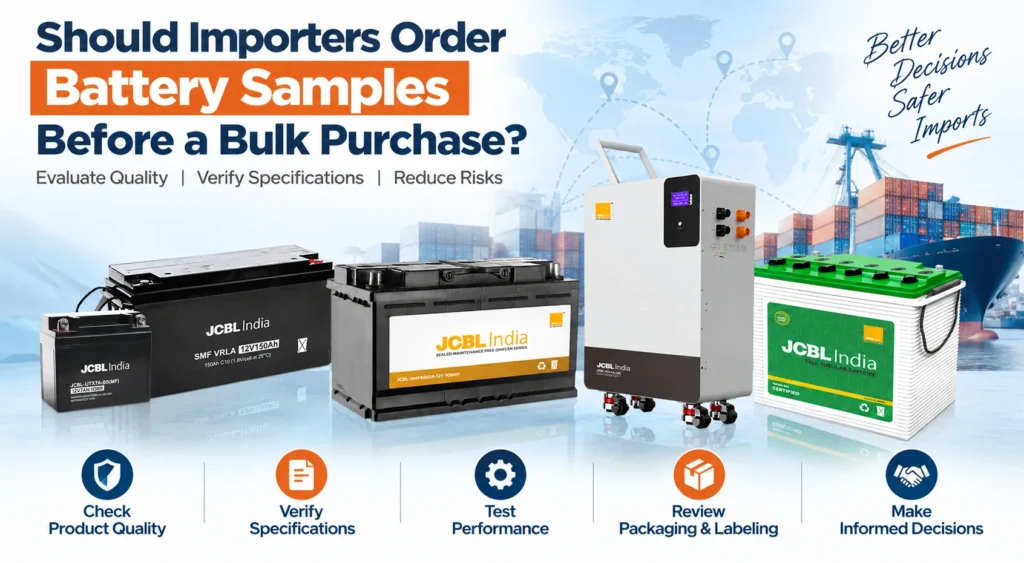
Ordering a battery sample before a bulk purchase gives importers an opportunity to verify the product before making a larger financial commitment. It allows buyers to check the battery’s specifications, physical construction, performance, packaging, labeling, and documentation against the agreed requirements. This step becomes especially important when sourcing from a new supplier, purchasing a customized battery, changing specifications, or placing a high-volume order.
In B2B battery procurement, the sample should be treated as an early quality-control checkpoint, not simply a product preview. It helps importers determine whether the physical product matches the supplier’s quoted specifications and whether any issues need to be resolved before the bulk order is approved.
Why Should Importers Order Battery Samples?
A supplier’s quotation, datasheet, product photographs, and technical specifications are useful during the sourcing stage, but they cannot fully establish the quality of the physical product.
A battery sample allows an importer to compare the actual product against the agreed purchasing specification before placing a larger order.
Depending on the battery and its intended application, sampling can help identify:
- Incorrect voltage or capacity
- Differences in dimensions or terminal configuration
- Poor casing or connector quality
- Inconsistent labeling or markings
- Packaging weaknesses
- Performance that does not meet requirements
- Missing or unsuitable documentation
This matters because the cost of discovering a problem after a bulk shipment arrives can be considerably higher than identifying it during the sample stage.
What Should Importers Check in a Battery Sample?
A sample evaluation should be based on the exact requirements agreed with the supplier. The checks will vary by battery type and application, but four areas are particularly important.
1. Verify the Battery Specifications
First, compare the physical sample with the supplier’s approved specifications.
Check:
- Battery type and chemistry
- Rated voltage
- Rated capacity
- Dimensions
- Weight
- Terminal or connector configuration
- Model or part number
- Polarity and product markings
A battery that looks similar to the requested product may still have different electrical or physical characteristics. The sample should therefore correspond to the exact model and specification intended for the bulk order.
2. Inspect Physical Construction
Examine the sample for visible quality issues before moving to technical testing.
Look at:
- Casing and overall construction
- Cracks, deformation, leakage, or visible damage
- Terminal condition
- Connectors and wiring, where applicable
- Labels and markings
- Packaging and protective materials
This inspection can also reveal whether the supplier’s packaging is appropriate for storage, handling, and transportation.
3. Test Performance for the Intended Application
Where testing is appropriate, evaluate the characteristics that matter for the battery’s actual end use.
Depending on the product, this could include capacity, charging and discharge behavior, operating performance, or other application-specific characteristics.
Testing should be based on the agreed technical specification and applicable test method, rather than a generic pass/fail assumption.
For technically demanding, safety-critical, or high-value purchases, an importer may also consider independent laboratory testing.
4. Review Documentation
Product evaluation should include the relevant documentation provided by the supplier.
Depending on the battery and destination market, this may include:
- Technical datasheets
- Test reports
- Safety documentation
- Product identification
- Batch or lot information
- Applicable transport documentation
- Required conformity or compliance records
For lithium batteries, transport requirements deserve particular attention. The UN Manual of Tests and Criteria contains specific testing provisions for lithium cells and batteries under subsection 38.3.
Importantly, passing an importer’s product inspection does not by itself establish regulatory or transport compliance. Applicable requirements depend on factors such as battery type, destination, transport mode, and intended use.
When Should Importers Definitely Order Battery Samples?
Sampling is especially advisable when:
- Buying from a new supplier: The importer has no established quality history with the manufacturer.
- Changing the battery specification: Even a small specification change can affect suitability.
- Placing a large or high-value order: The financial exposure is greater.
- The battery is critical to the end product: Failure can affect the buyer’s customers or equipment.
- Ordering customized or private-label batteries: Additional specifications need to be verified.
- The supplier has not supplied the exact model before: Previous experience with a supplier does not automatically validate a new product.
- Quality consistency is important: Multiple samples can help assess unit-to-unit consistency.
For routine repeat purchases from an established supplier, the buyer may already have an approved product specification and quality-control process. Even then, additional sampling may be appropriate if the model, manufacturing process, production location, or specification changes.
How Many Battery Samples Should an Importer Order?
There is no universal sample quantity that applies to every battery purchase.
The appropriate number depends on:
- Battery type
- Order volume
- Number of product variants
- Testing requirements
- Application risk
- Supplier history
- Required consistency
For a new supplier or significant order, testing multiple units can provide more useful information about consistency than evaluating only one battery.
The goal is not to obtain a specific number of samples simply for the sake of sampling. The goal is to collect enough evidence to make a reasonable go/no-go purchasing decision.
Should Battery Samples Be Tested In-House or by a Third-Party Lab?
Both approaches have a place in B2B procurement.
| Approach | Best suited for |
| In-house inspection | Dimensions, physical condition, markings, packaging, and basic specification checks |
| In-house performance testing | Applications where the buyer has appropriate equipment and technical expertise |
| Third-party laboratory | Independent technical, safety, or compliance-related verification |
| Combined approach | High-value, safety-critical, or technically complex purchases |
The appropriate level of testing should match the commercial and technical risk of the order.
A third-party laboratory can provide independent evidence, but it does not replace the importer’s responsibility to confirm that the product matches the purchasing specification and that applicable requirements are addressed.
What Should Happen After a Battery Sample Passes?
A successful sample should not simply be marked “approved” and forgotten.
The approved sample should become the reference standard for the bulk order.
Document the agreement:
- Battery model
- Voltage and capacity
- Dimensions and configuration
- Labeling and markings
- Packaging
- Performance requirements
- Documentation requirements
- Acceptable quality criteria
Keep the sample evaluation results and supplier communications as part of the purchasing record.
This creates a clear reference point if questions arise later about whether the bulk shipment matches the approved product.
However, sample approval does not guarantee that every unit in a bulk shipment will be identical. Consistent production depends on the supplier’s manufacturing and quality-control processes.
For larger purchases, importers may also consider pre-shipment inspection or other quality checks before the goods leave the supplier.
What If the Battery Sample Fails?
A failed sample can be valuable because it identifies a problem before the importer makes a larger commitment.
Use a straightforward process:
Identify the issue → discuss it with the supplier → request corrective action → obtain a revised sample if necessary → retest → approve or reject
For example, if the sample has the correct physical dimensions but does not meet the agreed performance requirements, the importer can ask the supplier to investigate the cause before production of the bulk order.
If the supplier cannot consistently meet the agreed specification, the importer can reconsider the supplier rather than discovering the problem after receiving a large shipment.
Battery Sample Red Flags Importers Should Not Ignore
Certain warning signs deserve closer attention:
- The sample’s markings do not match the datasheet.
- Different samples show noticeable differences in construction or specifications.
- Test results significantly differ from stated ratings.
- The supplier cannot provide requested technical documentation.
- Packaging appears unsuitable for the intended shipment.
- The supplier changes the specification without clear approval.
- The supplier discourages reasonable inspection or testing.
- The supplier asks the importer to approve the product without providing agreed information.
One issue does not automatically mean a supplier should be rejected. However, unexplained discrepancies should be resolved before the bulk purchase is finalized.
Are Battery Samples Worth the Extra Cost?
For most significant B2B purchases, sampling should be viewed as a risk-control expense rather than simply an additional purchasing cost.
A sample may involve product, shipping, testing, and administrative expenses. A bulk order can involve substantially larger commitments, including inventory, freight, customs clearance, storage, and customer obligations.
Sampling cannot eliminate every procurement risk. It does, however, give the importer more information before making the larger financial commitment.
The practical question is therefore not simply
“How much does the sample cost?”
It is:
“How much purchasing risk am I willing to accept without verifying the product?”
Conclusion
A battery sample allows importers to verify the product before committing to a large purchase. Reviewing the sample against the agreed specifications can help identify quality, performance, packaging, or documentation issues early, when they are still easier to address.
For new suppliers, customized batteries, high-volume orders, or critical applications, sampling is more than an extra purchasing step. It is a practical quality-control measure that helps importers reduce avoidable risks and enter bulk purchases with greater confidence.
FAQs
Not necessarily for every repeat purchase, but sampling is strongly advisable when working with a new supplier, new specification, customized battery, or significant-volume order.
Check the agreed specifications, physical condition, labeling, packaging, documentation, and application-specific performance requirements.
No. A sample verifies the units tested. Bulk quality also depends on production consistency, quality controls, and adherence to the approved specification.
This is generally a commercial matter between the importer and supplier. Some suppliers charge for samples, while others may credit the sample cost against a subsequent bulk order.
There is no universal testing period. It depends on the battery type, intended application, performance requirements, and applicable test method.