

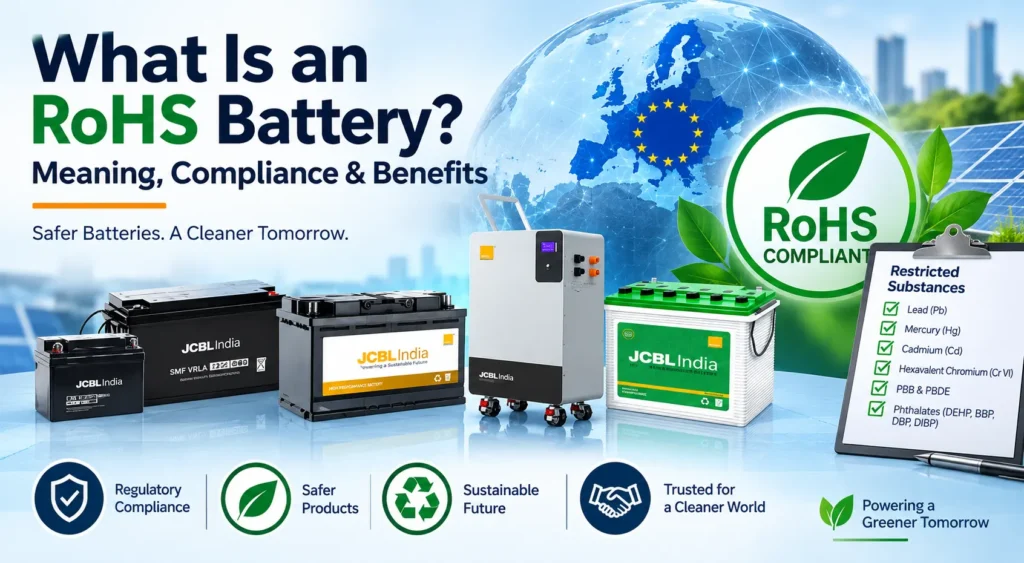
A RoHS battery is a battery or battery component that a supplier may describe as meeting applicable RoHS-related substance requirements. However, RoHS is not a standalone battery certification. The EU RoHS framework primarily restricts certain hazardous substances in electrical and electronic equipment (EEE), while batteries are subject to separate battery-specific requirements under Regulation (EU) 2023/1542.
For OEMs, manufacturers, importers, distributors, and procurement teams, understanding this distinction is important when sourcing batteries for products sold in the European Union.
What Is a RoHS Battery? Meaning of RoHS
RoHS stands for Restriction of Hazardous Substances. A “RoHS battery” generally refers to a battery or battery component that a supplier identifies as meeting applicable RoHS substance requirements or supporting the RoHS compliance of an electrical or electronic product.
The EU RoHS framework is established primarily through Directive 2011/65/EU, which restricts specified hazardous substances in applicable electrical and electronic equipment (EEE). However, standalone batteries are not regulated as EEE under RoHS 2. The European Commission’s RoHS guidance confirms that batteries are outside the scope of RoHS 2 and are subject to separate battery-specific requirements.
Therefore, “RoHS compliant” should not be treated as a universal battery certification. When sourcing a battery, B2B buyers should check what the supplier’s declaration actually covers, including the exact battery model, components, materials, and intended application, and separately assess applicable requirements under the EU Batteries Regulation (EU) 2023/1542.
Which Substances Does RoHS Restrict?
The current RoHS framework restricts 10 substances:
| Restricted substance | Abbreviation |
| Lead | Pb |
| Mercury | Hg |
| Cadmium | Cd |
| Hexavalent chromium | Cr(VI) |
| Polybrominated biphenyls | PBB |
| Polybrominated diphenyl ethers | PBDE |
| Bis(2-ethylhexyl) phthalate | DEHP |
| Butyl benzyl phthalate | BBP |
| Dibutyl phthalate | DBP |
| Diisobutyl phthalate | DIBP |
For most restricted substances, the maximum concentration is generally 0.1% by weight in homogeneous material. For cadmium, the limit is 0.01%. Specific exemptions can apply to defined uses and product categories.
RoHS compliance, therefore, does not mean that a product contains zero hazardous chemicals. It means that specified restricted substances remain within applicable legal limits, taking relevant exemptions into account.
Are Batteries Covered by RoHS?
Standalone batteries are not covered by RoHS as EEE. The European Commission’s RoHS FAQ explicitly states that batteries are outside the scope of RoHS 2.
However, this does not mean batteries used in electronic products can be ignored during product compliance assessments.
For example, an OEM may purchase a rechargeable battery pack for use in an electronic device. The finished electrical or electronic equipment may fall within the RoHS scope, while the battery itself is assessed under applicable battery requirements and other relevant legislation.
This distinction prevents a common compliance mistake: assuming that a supplier’s “RoHS compliant battery” statement automatically demonstrates compliance with every EU requirement applicable to the battery or finished product.
RoHS vs. EU Batteries Regulation
RoHS and the EU Batteries Regulation address different regulatory areas.
| Factor | RoHS | EU Batteries Regulation |
| Main legislation | Directive 2011/65/EU | Regulation (EU) 2023/1542 |
| Main focus | Restricted substances in applicable EEE | Battery sustainability, safety, information, and lifecycle requirements |
| Primary scope | Electrical and electronic equipment | Batteries placed on the EU market |
| Substance controls | Yes | Yes, through battery-specific provisions |
| Lifecycle requirements | More limited | Broader lifecycle approach |
| B2B relevance | EEE product compliance | Battery and supply-chain compliance |
In simple terms, RoHS regulates specified hazardous substances in applicable electrical and electronic equipment, while the EU Batteries Regulation specifically establishes requirements for batteries.
The Batteries Regulation entered into force in 2023 and takes a lifecycle approach covering areas such as sourcing, manufacturing, use, collection, recycling, and repurposing.
The regulatory requirements continue to develop. For example, the European Commission issued additional guidance and a delegated regulation in July 2026 concerning the removability and replaceability of certain portable batteries.
What Are the RoHS Compliance Requirements?
RoHS is an EU directive rather than a voluntary battery standard. For products within the RoHS scope, compliance involves assessing applicable substance restrictions and maintaining appropriate technical documentation.
For B2B battery procurement, buyers should consider:
1. Restricted Substance Limits
Relevant materials in an applicable EEE product must comply with the RoHS maximum concentration limits, subject to applicable exemptions.
2. Product-Specific Documentation
Suppliers may provide documents such as:
- RoHS declarations
- Material declarations
- Laboratory test reports
- Technical documentation
- Supplier compliance statements
3. Exact Product Identification
Documentation should clearly relate to the specific battery, model, part number, or component being purchased. A generic declaration may provide less assurance than product-specific documentation.
4. Applicable Exemptions
RoHS exemptions exist for certain applications and are subject to specific conditions and review. Buyers should verify whether an exemption applies rather than assuming that any restricted substance automatically makes a product non-compliant.
5. Other Applicable EU Requirements
A RoHS declaration should not be used as a substitute for assessing battery-specific requirements. Batteries placed on the EU market may need to meet obligations under Regulation (EU) 2023/1542, depending on the battery type, product, economic operator, and intended market.
What Are the Benefits of RoHS-Compliant Components?
For B2B buyers and OEMs, properly documented RoHS compliance can provide several practical benefits.
- Supports Product Compliance: Using components with appropriate substance documentation can support manufacturers in meeting applicable requirements for EEE placed on the EU market.
- Helps With Supplier Qualification: RoHS declarations and supporting material documentation give procurement and engineering teams evidence to evaluate during supplier approval.
- Improves Traceability: Product-specific compliance records can create a clearer documentation trail for audits, supplier reviews, and technical assessments.
- Reduces Substance-Compliance Risk: Verifying restricted-substance information before purchasing can reduce the risk of discovering material-compliance issues later in the manufacturing or market-access process.
How to Verify RoHS Compliance for a Battery
For businesses sourcing batteries, use this practical checklist:
- Identify the exact battery model and intended application.
- Determine whether the finished electrical or electronic product falls within RoHS scope.
- Ask the supplier for a current RoHS declaration where relevant.
- Confirm that the documentation identifies the exact product or part number.
- Request material declarations or test reports when appropriate.
- Check whether any RoHS exemption is relevant.
- Assess separate requirements under the EU Batteries Regulation.
- Keep compliance records with your purchasing and technical documentation.
For regulated or technically complex applications, compliance documentation should be reviewed by the appropriate regulatory or technical professional.
What Should B2B Buyers Ask a Battery Supplier?
Before placing a bulk battery order, ask the supplier:
- Does the exact battery model have a current RoHS declaration?
- What material or substance documentation is available?
- Does the declaration cover the complete battery or only specified components?
- Can relevant test reports be provided?
- What EU battery compliance documentation is available?
- Is the battery intended for use in RoHS-regulated EEE?
- How are material or regulatory changes communicated to customers?
These questions help buyers evaluate documented compliance rather than relying only on a “RoHS compliant” label.
Is There a RoHS Certificate for Batteries?
There is no universal EU government-issued “RoHS battery certificate.” RoHS compliance for products within its scope is demonstrated through the applicable conformity-assessment process and supporting technical documentation.
A supplier may provide a RoHS declaration, material declaration, test report, or other compliance documentation. Buyers should check that the evidence corresponds to the relevant product and application.
For standalone batteries, this documentation should not be treated as proof of compliance with all requirements under the EU Batteries Regulation.
RoHS Battery vs. Unverified Battery
The practical difference is documented compliance information versus uncertainty.
A battery supported by product-specific supplier documentation gives an OEM or importer more information for its compliance assessment. An unverified battery may leave the buyer without sufficient evidence about material composition or the suitability of the component for a particular application.
For B2B procurement, the objective should therefore be to verify the specific product, documentation, intended use, and applicable regulations rather than simply selecting a battery advertised as “RoHS.”
Conclusion
A “RoHS battery” is primarily a supplier or procurement term, not a standalone EU battery certification. The EU RoHS Directive restricts specified hazardous substances in applicable electrical and electronic equipment, while batteries are subject to separate battery-specific legislation.
For OEMs, manufacturers, importers, and distributors, the safest approach is to verify the exact battery model, supplier documentation, intended application, and applicable EU requirements. If the battery is used in electrical or electronic equipment, assess RoHS requirements for the finished product; for the battery itself, also consider the requirements of Regulation (EU) 2023/1542.
This approach supports more reliable battery sourcing, supplier qualification, technical documentation, and EU market compliance.
FAQs
A RoHS battery is generally a battery or battery component that a supplier identifies as meeting applicable RoHS substance requirements. However, standalone batteries are not themselves within the scope of RoHS 2; battery-specific requirements apply separately.
No. Standalone batteries are not covered by RoHS as electrical and electronic equipment. Batteries are regulated separately under applicable EU battery legislation.
RoHS currently restricts 10 substances: lead, mercury, cadmium, hexavalent chromium, PBB, PBDE, DEHP, BBP, DBP, and DIBP.
No. RoHS restricts specified substances to applicable concentration limits. It does not mean that a product contains zero hazardous substances.
Check the exact product against relevant supplier documentation, such as a RoHS declaration, material declaration, or test report. Then determine whether the finished EEE falls within RoHS scope and assess other applicable regulations.
No. RoHS primarily addresses restricted substances in applicable EEE, while Regulation (EU) 2023/1542 establishes requirements specifically for batteries and their lifecycle.