

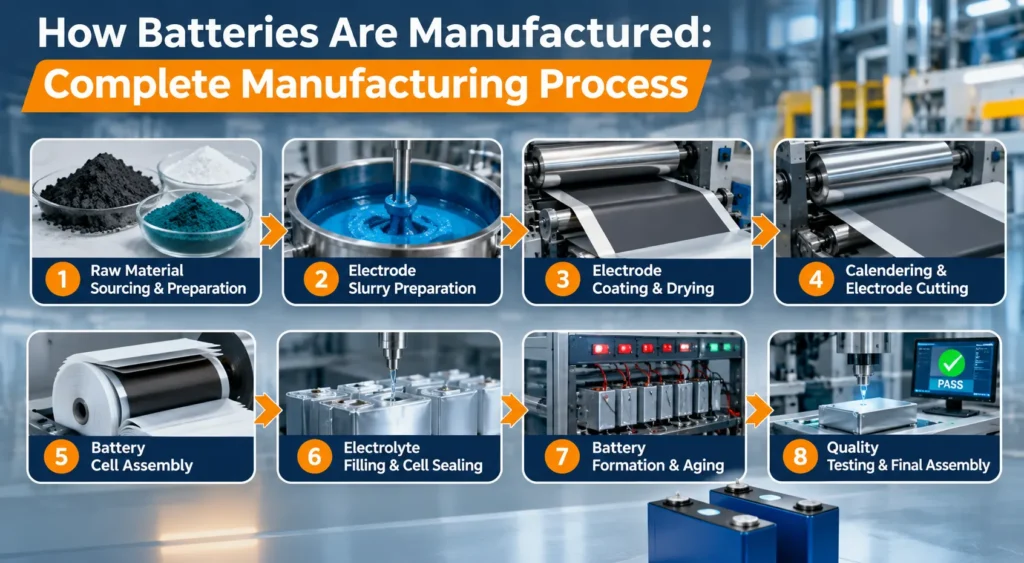
Batteries are manufactured through a sequence of material preparation, electrode production, cell assembly, electrochemical activation, and quality testing. In lithium-ion battery manufacturing, the process starts with preparing cathode and anode materials, followed by coating metal foils, assembling battery cells, filling them with electrolyte, and testing their performance. Each stage requires controlled processing conditions to ensure consistent battery capacity, reliability, and safety.
What Are the Main Stages of Battery Manufacturing?
The lithium-ion battery manufacturing process consists of three major production phases:
Electrode manufacturing
Preparing, coating, drying, and cutting cathode and anode materials.
Cell assembly
Combining electrodes and separators, connecting components, filling electrolyte, and sealing the cell.
Cell finishing
Performing initial charge-discharge cycles, ageing, and quality testing.
After cell production, manufacturers may assemble individual cells into battery modules and packs for applications such as electric vehicles, energy storage systems, and electronic devices.
Complete Battery Manufacturing Process: Step by Step
Raw Material Sourcing and Preparation
Battery production begins with sourcing and inspecting the materials required to manufacture electrodes and other cell components.
The main materials used in lithium-ion battery manufacturing include:
- Cathode materials: Lithium iron phosphate (LFP) and nickel manganese cobalt (NMC), depending on the battery chemistry.
- Anode materials: Primarily graphite in conventional lithium-ion cells.
- Electrolyte: A lithium salt dissolved in organic solvents that enables ion movement.
- Separator: A porous polymer membrane that prevents direct contact between electrodes while allowing lithium ions to pass through.
- Current collectors: Aluminium foil for cathodes and copper foil for anodes.
Manufacturers check material purity, particle size, moisture content, and consistency before production. Material quality directly influences electrode uniformity and cell performance.
Electrode Slurry Preparation
The cathode and anode materials are processed separately to prepare electrode slurries.
Active materials are mixed with conductive additives, binders, and suitable solvents to create uniform mixtures. Industrial mixers distribute these components evenly and help remove trapped air.
Slurry consistency, viscosity, and particle distribution are important because they influence coating uniformity, electrode adhesion, and electrical performance.
Electrode Coating and Drying
The prepared slurries are applied to metal current collectors using precision coating equipment, commonly slot-die coating machines.
The cathode slurry is coated onto aluminium foil, while the anode slurry is applied to copper foil. These coated sheets then pass through controlled drying ovens to remove processing solvents.
Uniform coating thickness and proper drying help prevent defects such as cracks, uneven material distribution, and poor adhesion.
Calendering and Electrode Cutting
After drying, electrode sheets pass through precision rollers in a process called calendering. The rollers compress the coatings to achieve the required thickness, density, and porosity.
These properties affect electrolyte penetration, electrode structure, and battery performance.
The electrode sheets are then slit into narrower rolls and cut or notched according to the cell design. Secondary vacuum drying may also be performed to remove residual moisture before cell assembly.
Battery Cell Assembly
Cell assembly involves combining the cathode, anode, and separator into a compact internal structure.
Manufacturers generally use two methods:
- Stacking: Individual electrode and separator sheets are arranged in alternating layers.
- Winding: Continuous electrode and separator sheets are rolled into a compact structure.
The assembled components are placed inside a suitable enclosure. Depending on the design, lithium-ion cells are manufactured in cylindrical, prismatic, or pouch formats.
Electrode tabs are connected using welding techniques to establish electrical connections. Precise alignment is essential to prevent internal defects and maintain cell consistency.
Electrolyte Filling and Cell Sealing
Once the cell structure is assembled, electrolyte is introduced to enable lithium-ion movement between the electrodes during charging and discharging.
Vacuum-assisted filling systems help distribute the electrolyte throughout the porous electrode and separator structures.
This stage requires strict moisture control because water contamination can trigger unwanted reactions with electrolyte components and affect cell reliability. Therefore, lithium-ion cell assembly and electrolyte filling are performed in controlled dry-room environments.
After filling, the cell is sealed and inspected for leakage.
Battery Formation and Aging
Battery formation is the initial controlled charging and discharging process performed after cell assembly.
During formation, electrochemical reactions occur at the electrode surfaces. In conventional graphite-anode lithium-ion cells, this includes the development of a solid electrolyte interphase (SEI), which helps stabilize the anode-electrolyte interface.
After formation, cells undergo aging under controlled conditions. Manufacturers monitor voltage, self-discharge, and other electrical characteristics to identify cells that do not meet production specifications.
Some cell designs also require degassing and resealing after formation.
Battery Testing and Quality Inspection
Battery testing verifies whether manufactured cells meet their specified electrical, physical, and safety requirements.
Common quality control checks include:
Testing method What it evaluates Capacity testing Electrical charge a cell can deliver Voltage testing Cell voltage within specified limits Internal resistance testing Electrical resistance within the cell Leak testing Cell enclosure and sealing integrity Insulation testing Electrical insulation and isolation Visual inspection Physical damage and manufacturing defects Manufacturers also conduct application-specific performance, durability, and safety testing according to relevant specifications and standards.
Quality control takes place throughout production, not just after the battery is completed.
Battery Module and Pack Assembly
Once individual cells pass inspection, they can be integrated into modules or directly into battery packs, depending on the system design.
Multiple cells are connected in series or parallel to achieve the required voltage and capacity. The assembly may include:
- Busbars and electrical connections
- Battery Management System (BMS)
- Thermal management components
- Protective enclosures
- Electrical safety devices
The BMS monitors parameters such as cell voltage and temperature and helps manage charging and discharging. The completed battery pack undergoes electrical, functional, and safety checks before being approved for its intended application.
What Machines Are Used in Battery Manufacturing?
Battery manufacturing requires specialised machinery to maintain production accuracy, consistency, and efficiency.
| Manufacturing stage | Equipment used |
|---|---|
| Material preparation | Dosing systems and industrial mixers |
| Slurry preparation | Vacuum planetary mixers |
| Electrode coating | Slot-die coating machines |
| Drying | Industrial drying ovens |
| Calendering | Precision roller presses |
| Electrode cutting | Slitting and notching machines |
| Cell assembly | Stacking and winding machines |
| Electrolyte filling | Vacuum filling systems |
| Cell formation | Battery charging and discharging systems |
| Quality inspection | Capacity and resistance testing equipment |
| Pack assembly | Welding and automated assembly systems |
The equipment configuration varies according to battery chemistry, cell format, manufacturing capacity, and production technology.
How Are Different Types of Batteries Manufactured?
Battery manufacturing processes differ according to the materials and electrochemical systems used.
Lithium-ion batteries: Manufacturing involves electrode slurry preparation, coating, drying, calendering, cell assembly, electrolyte filling, formation, and testing.
Lead-acid batteries: Production includes lead oxide preparation, grid casting, plate pasting, curing, cell assembly, electrolyte filling, and formation.
Nickel-metal hydride (NiMH) batteries: Manufacturing involves preparing positive and negative electrodes, assembling them with separators, electrolyte filling, sealing, and forming.
Although all three battery types store electrical energy, their raw materials, electrode structures, and manufacturing requirements are different.
What Quality Control Measures Are Used in Battery Manufacturing?
Battery manufacturers use quality control checkpoints throughout the production process to identify defects and maintain consistent output.
Important measures include:
Material inspection
Verifying raw material purity, composition, and moisture levels.
Electrode inspection
Measuring coating thickness, weight, uniformity, and adhesion.
Environmental monitoring
Controlling humidity and contamination in critical production areas.
Assembly inspection
Checking electrode alignment, welding quality, and cell sealing.
Electrical testing
Evaluating voltage, capacity, and internal resistance.
Final validation
Conducting application-specific performance and safety tests.
These checks help manufacturers identify process variations, reduce production defects, and ensure finished batteries meet their design specifications.
Conclusion
Battery manufacturing involves multiple interconnected stages, from raw material preparation and electrode production to cell assembly, formation, and final testing. Precision in coating, moisture control, electrode alignment, electrolyte filling, and electrical inspection is essential for producing consistent and reliable batteries. Understanding these stages provides a clearer picture of how raw materials are transformed into finished battery cells and packs for modern energy storage applications.
FAQs
How are batteries manufactured step by step?
Batteries are manufactured by preparing raw materials, producing electrodes, coating and drying electrode sheets, assembling cells, filling them with electrolyte, performing formation cycles, and testing their performance. Approved cells may then be assembled into modules or battery packs.
What raw materials are used in battery manufacturing?
Lithium-ion batteries commonly use cathode materials such as LFP or NMC, graphite for the anode, lithium-based electrolyte salts, polymer separators, binders, conductive additives, and aluminium and copper current collectors.
How are lithium-ion battery cells assembled?
Lithium-ion cells are assembled by arranging cathodes, anodes, and separators through stacking or winding. The structure is placed inside a cell enclosure, connected through electrode tabs, filled with electrolyte, and sealed.
What machines are used to manufacture batteries?
Common battery manufacturing equipment includes industrial mixers, coating machines, drying ovens, calendering rollers, slitting machines, stacking and winding systems, vacuum electrolyte fillers, formation equipment, and electrical testing systems.
What is the difference between battery cell and battery pack manufacturing?
Cell manufacturing produces individual electrochemical units containing electrodes, separators, and electrolyte. Pack manufacturing connects multiple cells and integrates components such as the BMS, electrical connections, thermal management, and protective housing.
How long does it take to manufacture a battery?
Battery manufacturing time depends on chemistry, cell design, production capacity, and formation and aging requirements. While electrode processing and cell assembly take place on production lines, formation and aging can add significant time to the overall process.