

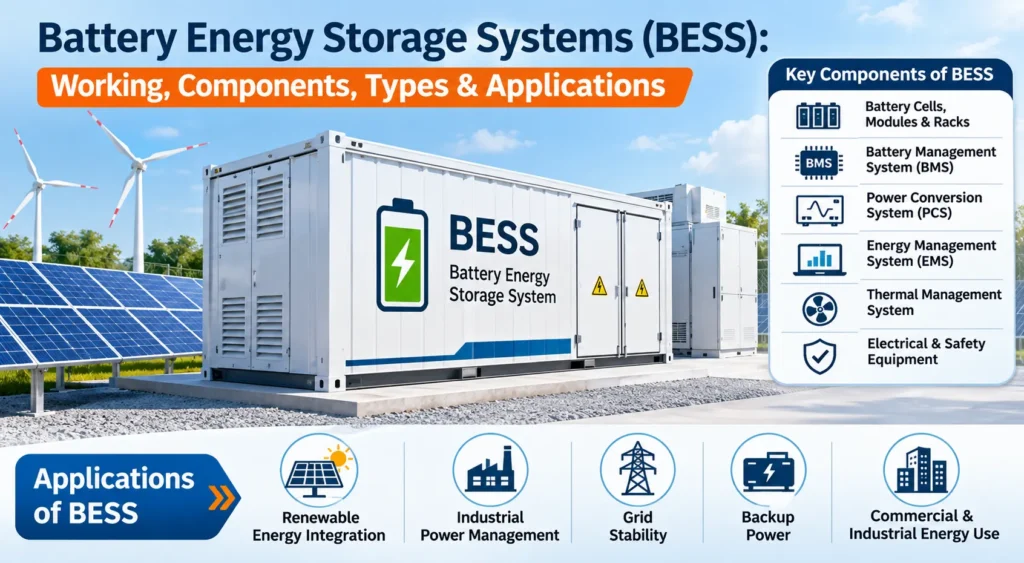
As electricity demand grows and renewable energy generation spreads, maintaining a reliable balance between supply and demand is a major challenge. Battery Energy Storage Systems (BESS) help address this challenge by storing electricity and supplying it when required. They support renewable energy integration, industrial power management, and grid stability by making stored electricity available when generation is low or demand increases. For businesses, utilities, and renewable energy developers, BESS offers a flexible approach to managing electricity requirements and improving energy infrastructure.
What Is a Battery Energy Storage System (BESS)?
A Battery Energy Storage System (BESS) is an integrated system that stores electricity in rechargeable batteries and releases it when needed. It combines battery cells, power conversion equipment, battery management systems, and energy control software to regulate energy storage and distribution.
Unlike a standalone battery, BESS includes the electrical, monitoring, and safety infrastructure required to connect stored energy with industrial facilities, renewable energy installations, or electricity grids.
How Does a Battery Energy Storage System Work?
A BESS stores electricity through an electrochemical process and converts it into usable electrical power when required. Its operation involves five main stages:
- Energy Input: Electricity enters the system from the grid, solar panels, wind turbines, or other generation sources.
- Power Conversion: During charging, the Power Conversion System (PCS) converts alternating current (AC) into direct current (DC), which the batteries store.
- Battery Charging and Monitoring: The Battery Management System (BMS) monitors voltage, current, and temperature while managing battery charging within specified operating limits.
- Energy Discharge: When electricity is needed, stored DC power passes through the PCS, which converts it into AC for connected loads or grid supply.
- Energy Distribution: The Energy Management System (EMS) controls charging and discharging based on electricity demand, operating schedules, and energy management objectives.
AC-Coupled vs. DC-Coupled BESS
Battery storage systems connected to solar installations generally use one of two configurations:
AC-Coupled Systems:
The solar installation and battery storage system connect separately on the AC side through their respective power conversion equipment. This configuration is often suitable for adding battery storage to existing solar installations.
DC-Coupled Systems:
Solar panels and batteries connect on the DC side through compatible conversion equipment. This arrangement can reduce conversion stages and may improve energy utilisation in suitable system designs.
The choice depends on existing infrastructure, inverter compatibility, installation requirements, and project economics.
What Are the Main Components of a BESS?
A battery energy storage system consists of several interconnected components that manage energy storage, conversion, monitoring, and safety.
Battery Cells, Modules and Racks:
Cells store energy through electrochemical reactions. Multiple cells form modules, which are assembled into racks to achieve the required voltage and storage capacity.
Battery Management System (BMS):
Monitors cell voltage, current, temperature, State of Charge (SOC), and State of Health (SOH). It helps prevent operation outside specified safety limits.
Power Conversion System (PCS):
Converts AC electricity into DC for charging and DC into AC during discharge. Depending on system design, the PCS incorporates the inverter.
Energy Management System (EMS):
Coordinates system operation, controls energy flow, and optimizes charging and discharging according to demand and operating requirements.
Thermal Management System:
Uses air or liquid cooling to maintain battery temperatures within specified operating ranges.
Electrical and Safety Equipment:
Includes transformers, switchgear, circuit breakers, protective devices, fire detection, and suppression systems.
Together, these components enable the BESS to operate as an integrated energy storage installation.
What Are the Different Types of Battery Energy Storage Systems?
BESS technologies use different battery chemistries, each offering distinct characteristics, operating requirements, and application suitability.
| Battery Type | Key Characteristics | Typical Applications |
|---|---|---|
| Lithium Iron Phosphate (LFP) | Good thermal stability, long cycle life, and suitability for stationary storage | Commercial, industrial, and grid-scale storage |
| Nickel Manganese Cobalt (NMC) | High energy density and compact design | Applications where space and energy density matter |
| Lead-Acid | Established technology, lower initial cost, and relatively shorter cycle life | Backup power and smaller storage systems |
| Sodium-Sulfur (NaS) | High-temperature operation and suitability for extended discharge | Large-scale stationary storage |
| Flow Batteries | Liquid electrolyte storage with independently scalable energy capacity | Long-duration stationary storage |
Lithium-ion technologies, particularly LFP and NMC, are widely used in stationary battery storage. LFP generally offers better thermal stability than NMC, although the appropriate chemistry depends on project requirements, cost, safety, and performance considerations.
What Are the Applications of Battery Energy Storage Systems?
BESS technology serves multiple applications across commercial, industrial, and utility energy infrastructure.
Renewable Energy Integration:
Stores surplus electricity generated by solar and wind installations for use when renewable generation decreases.
Commercial and Industrial Energy Management:
Helps factories, manufacturing plants, and commercial facilities manage peak demand and optimize electricity consumption.
Grid Stabilization:
Supports frequency regulation, grid balancing, and other services required to maintain reliable electricity supply.
Backup Power:
Supplies stored electricity during grid interruptions to support designated critical loads, depending on system configuration.
Microgrids and Off-Grid Systems:
Balance local electricity generation, battery storage, and connected loads in independent or semi-independent power networks.
Utility-Scale Energy Storage:
Stores electricity during periods of surplus supply and releases it during periods of higher demand.
What Are the Benefits of Battery Energy Storage Systems?
For businesses and energy operators, BESS offers several operational and commercial advantages:
Energy Reliability:
Provides an additional source of electricity during grid disturbances.
Peak Demand Management:
Reduces grid electricity consumption during high-demand periods by supplying stored energy.
Renewable Energy Utilization:
Captures surplus renewable electricity that might otherwise be curtailed.
Electricity Cost Management:
Supports time-of-use energy shifting and demand charge management where electricity tariffs make these strategies economical.
Grid Flexibility:
Helps electricity networks respond to fluctuations in generation and consumption.
Decarbonization Support:
Facilitates greater use of renewable electricity and can reduce dependence on fossil-fuel-based power generation.
Actual financial and environmental benefits depend on system design, electricity tariffs, energy sources, and operating conditions.
Key Factors to Consider When Choosing a BESS
Selecting a battery energy storage system requires evaluating electricity demand, project objectives, installation conditions, and long-term operating requirements.
- Energy Capacity (kWh/MWh): Measures the total amount of electricity the battery can store.
- Power Rating (kW/MW): Indicates how much power the system can deliver or absorb at a given time.
- Storage Duration: Determines how long the system can supply electricity at a specified power output. It is calculated by dividing usable energy capacity by discharge power.
- Battery Chemistry: Evaluate thermal stability, cycle life, energy density, cost, and application suitability.
- Round-Trip Efficiency: Measures how much energy is recovered after charging and discharging, accounting for conversion and system losses.
- Battery Degradation: Consider expected capacity retention, operating temperature, cycling requirements, and warranty conditions.
- Safety and Compliance: Assess thermal management, fire protection, electrical safeguards, and applicable installation standards.
- Scalability and Integration: Check grid compatibility, available installation space, monitoring capabilities, maintenance requirements, and future expansion options.
Example: A BESS with 10 MWh of usable energy capacity and a 5 MW discharge rating can theoretically deliver its rated power for two hours. Actual operating duration depends on conversion losses, reserve settings, and operating limits.
BESS vs. Other Energy Storage Technologies
BESS is one of several technologies used to store electricity. The main differences relate to storage methods, installation requirements, and operating applications.
| Technology | Storage Method | Typical Application |
|---|---|---|
| BESS | Electrochemical energy | Renewable integration, grid services, and industrial power management |
| Pumped Hydro | Gravitational potential energy using water | Large-scale grid storage |
| Compressed Air Energy Storage (CAES) | Compressed air | Large-scale and longer-duration storage |
| Flow Batteries | Energy stored in liquid electrolytes | Stationary and longer-duration storage |
Unlike pumped hydro and compressed air systems, BESS can be deployed in modular configurations without requiring specific geographical features such as suitable reservoirs or underground storage formations.
The right technology depends on project capacity, storage duration, location, infrastructure, and economic feasibility.
What Is the Future of Battery Energy Storage Systems?
The BESS industry is evolving through improvements in battery chemistry, power electronics, and energy management software. Developments in LFP and sodium-ion batteries, longer-duration storage technologies, and advanced monitoring systems are expanding the potential applications of battery storage.
As renewable electricity generation and grid flexibility requirements increase, BESS is expected to become an increasingly important part of commercial energy management and electricity infrastructure.
Conclusion
Battery energy storage systems are becoming an important part of modern energy infrastructure, supporting renewable energy integration, electricity management, and grid reliability. Their performance depends on selecting the appropriate battery chemistry, power rating, energy capacity, system architecture, and safety features.
For businesses, utilities, and renewable energy developers, understanding these technical factors is essential to selecting a BESS that meets operational requirements and supports long-term energy management objectives.
FAQs
1. What does BESS stand for?
BESS stands for Battery Energy Storage System. It is an integrated technology that stores electricity in rechargeable batteries and supplies it when required.
2. What is the main purpose of a BESS?
The main purpose of BESS is to store electricity for later use. It helps manage peak demand, integrate renewable energy, support grid operations, and provide backup power.
3. Which battery chemistry is commonly used in BESS?
Lithium-ion batteries, particularly LFP and NMC, are widely used in stationary energy storage. Other options include lead-acid, sodium-sulfur, and flow batteries.
4. How long can a BESS supply electricity?
Discharge duration depends on usable energy capacity and power output. For example, a system with 10 MWh of usable capacity and a 5 MW output can theoretically supply electricity for two hours at that power level.
5. Can BESS work with solar power systems?
Yes. BESS can store surplus solar electricity and release it when solar generation is insufficient, subject to system configuration and available stored energy.
6. What is the difference between BESS power capacity and energy capacity?
Power capacity, measured in kW or MW, indicates the rate at which electricity can be delivered. Energy capacity, measured in kWh or MWh, indicates the total amount of electricity stored.
7. How long does a battery energy storage system last?
BESS lifespan depends on battery chemistry, operating temperature, depth of discharge, cycling frequency, maintenance, and warranty conditions. Battery capacity gradually degrades with use and time.