

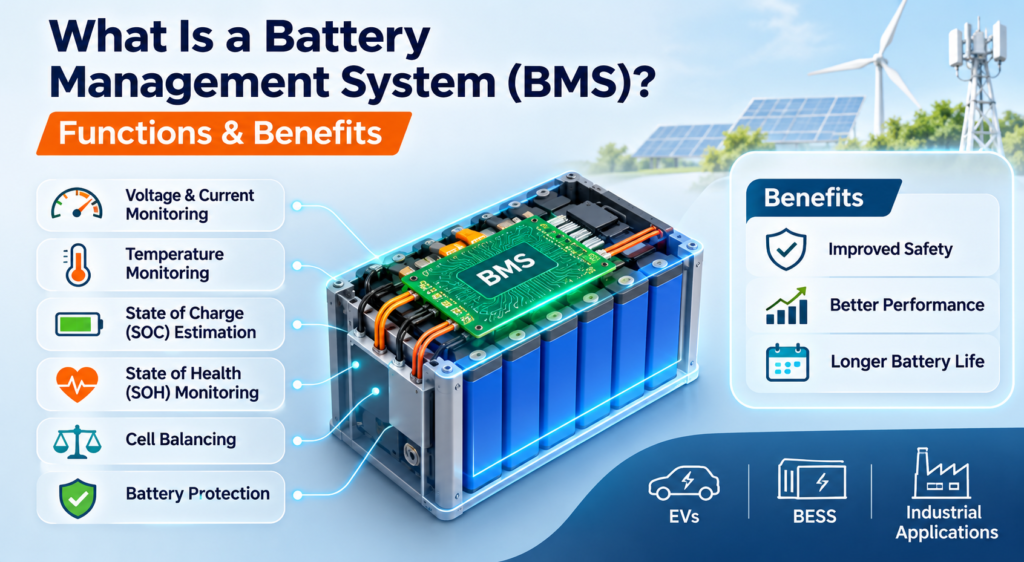
A Battery Management System (BMS) is an electronic system that monitors, controls, and protects rechargeable battery packs during charging and discharging. It measures critical parameters such as cell voltage, battery current, and temperature; estimates battery conditions; manages cell balancing; and initiates protective actions when operating limits are exceeded. A BMS is essential for maintaining the safety, performance, and reliability of lithium-ion batteries used in electric vehicles (EVs), battery energy storage systems (BESS), and industrial applications.
As battery-powered technologies expand across automotive, renewable energy, and industrial sectors, effective battery management has become increasingly important. Without proper monitoring and control, differences between individual cells and operation beyond specified limits can affect battery performance, accelerate degradation, and create safety risks.
What Is a Battery Management System?
A battery management system is an electronic control system that manages the electrical operation of a rechargeable battery pack. It collects data from individual cells, evaluates battery operating conditions, and coordinates charging, discharging, and protection functions to keep the battery within its specified operating limits.
A typical BMS consists of the following components:
Battery Management Unit (BMU)
Processes battery data, estimates operating conditions, and coordinates monitoring, balancing, and protection functions.
Cell Monitoring Units (CMUs)
Measure individual cell voltages and temperatures and execute cell-balancing commands.
Battery Disconnect Unit (BDU)
Contains switching and protection components, such as contactors and fuses, that manage the battery’s connection to external loads and chargers.
Sensors and Communication Interfaces
Collect electrical and thermal measurements and exchange information with connected systems.
Depending on the battery architecture, these functions may be integrated into fewer electronic modules or distributed across multiple units.
How Does a Battery Management System Work?
A BMS continuously collects battery data, evaluates operating conditions, and controls the battery’s interaction with connected equipment.
Its working process involves five stages:
- Data Collection: Voltage sensors measure individual cell voltages, current sensors track battery current, and temperature sensors monitor thermal conditions.
- Data Processing: The controller analyses these measurements to estimate State of Charge (SOC), State of Health (SOH), and other operating parameters.
- Operating Control: Based on battery conditions, the BMS determines permissible charging and discharging limits and manages cell balancing.
- Fault Detection: It identifies abnormal conditions such as overvoltage, undervoltage, excessive current, and temperature deviations.
- Protective Action: Depending on the fault and system design, it can restrict current, communicate warnings, or operate contactors to disconnect the battery.
This process allows the BMS to coordinate battery operation with chargers, inverters, vehicle controllers, and other connected equipment.
What Are the Main Functions of a Battery Management System?
A Battery Management System performs several interconnected functions to maintain battery safety, performance, and operational reliability.
Voltage and Current Monitoring
The BMS monitors individual cell voltages and overall battery current during charging and discharging. This helps identify electrical irregularities and ensures that cells operate within manufacturer-specified voltage limits.
Temperature Monitoring and Thermal Management
Battery temperature influences charging performance, power delivery, and service life. The BMS monitors cell and module temperatures and can coordinate with external cooling or heating systems to maintain suitable operating conditions.
State of Charge (SOC) Estimation
SOC represents the estimated remaining charge in a battery, generally expressed as a percentage. The BMS calculates SOC using current measurements, voltage readings, and battery-specific estimation models. This information helps determine available battery energy and manage charging and discharging.
State of Health (SOH) Monitoring
SOH indicates the battery’s condition compared with its original or specified performance. The BMS estimates SOH using parameters such as available capacity, internal resistance, and operating history. This helps track battery degradation and assess changes in its performance over time.
Cell Balancing
Individual cells in a battery pack can develop differences in charge levels because of variations in capacity, internal resistance, and ageing. Cell balancing helps reduce these differences.
The two primary cell-balancing methods are:
- Passive Cell Balancing: Dissipates excess energy from higher-charge cells through resistors, converting it into heat. It is relatively simple and cost-effective.
- Active Cell Balancing: Transfers energy from higher-charge cells to lower-charge cells using electronic circuits. It can reduce balancing energy losses but generally involves greater circuit complexity and cost.
Both methods help maintain more consistent cell utilisation within a battery pack.
Battery Protection
A BMS monitors operating conditions that could damage battery cells or create safety risks, including:
- Overcharging and overvoltage
- Deep discharging and undervoltage
- Excessive charging or discharging current
- Short circuits
- High or low operating temperatures
When a fault is detected, the BMS initiates an appropriate response through its control and protection hardware. Depending on the architecture, this may involve limiting current, generating an alert, or opening battery contactors. A BMS reduces operational risks but does not eliminate every possible battery failure.
Charging and Discharging Control
The BMS determines permissible charging and discharging conditions based on cell voltage, temperature, current, and battery status. It communicates these limits to chargers, inverters, or vehicle controllers so that the battery operates within its specified electrical and thermal limits.
Fault Detection and Communication
The BMS identifies abnormal readings, records relevant fault information, and communicates battery status to external systems. Common communication interfaces include CAN, RS485, and other application-specific protocols. This enables system coordination, diagnostics, and battery performance monitoring.
What Are the Benefits of a Battery Management System?
By combining battery monitoring, control, and protection, a BMS provides several operational benefits:
Improved Battery Safety
Monitors electrical and thermal conditions and initiates protective actions to reduce risks associated with overcharging, overcurrent, short circuits, and excessive temperatures.
Extended Battery Service Life
Helps minimise battery degradation by maintaining appropriate charging and discharging conditions and managing cell imbalances.
Better Battery Performance
Supports consistent cell operation and helps maintain usable battery capacity through monitoring and balancing.
Efficient Energy Utilisation
SOC estimation and coordinated charging and discharging provide better visibility into available battery energy and support effective energy management.
Early Fault Identification
Detects abnormal operating conditions and provides diagnostic information, helping operators identify potential issues before they lead to more serious disruptions.
Reliable System Operation
Coordinates battery monitoring and protection with connected equipment, supporting dependable operation across automotive, industrial and energy storage applications.
Where Are Battery Management Systems Used?
BMS technology is used across industries that depend on rechargeable battery systems.
Electric Vehicles (EVs)
Monitors traction battery packs and manages charging, discharging, and cell-level protection.
Battery Energy Storage Systems (BESS)
Monitors battery modules and manages operating conditions in commercial and grid-scale storage installations.
Solar Energy Storage Systems
Manages rechargeable batteries that store electricity generated by solar panels.
Industrial Equipment
Supports battery-powered machinery, material-handling equipment and industrial vehicles.
Telecommunications
Monitors backup battery systems used to maintain power during electrical interruptions.
UPS and Data Centres
Manages battery banks that provide backup power during supply disruptions.
BMS configurations differ across these applications depending on battery chemistry, voltage, capacity, operating environment, and system architecture.
What Should Businesses Consider When Selecting a Battery Management System?
For battery manufacturers, OEMs, and system integrators, selecting a BMS requires evaluating its compatibility with the battery pack and the intended application.
Key considerations include:
Battery Chemistry Compatibility
Verify support for the intended chemistry, such as Lithium Iron Phosphate (LFP) or Nickel Manganese Cobalt (NMC). Each chemistry has specific operating requirements.
Voltage and Current Ratings
Match the BMS to the battery pack’s nominal voltage, maximum operating voltage, continuous current, and peak current requirements.
Cell Configuration
Check the supported number of cells connected in series and parallel to ensure compatibility with the battery architecture.
Monitoring and Protection Features
Evaluate cell-level voltage monitoring, temperature sensing, balancing methods, fault detection, and protective switching.
Thermal Management Compatibility
Ensure the BMS can communicate with the battery’s cooling or heating system, where applicable.
Communication Protocols
Check compatibility with CAN, RS485, Modbus, or other interfaces required by connected chargers, inverters, and controllers.
Scalability and Integration
Assess whether the system supports the required battery modules, expansion configurations, and integration with the overall application.
The selected BMS should comply with the battery manufacturer’s operating specifications and the technical requirements of the complete battery system.
Conclusion
A battery management system is a critical component of modern rechargeable battery technology. By monitoring electrical and thermal conditions, estimating battery health, balancing individual cells, and managing protective responses, it helps maintain safe and reliable battery operation.
For battery manufacturers, OEMs, and energy storage solution providers, selecting a BMS that matches the battery chemistry, electrical specifications, cell configuration, and application requirements is essential for achieving dependable system performance and long-term operational reliability.
FAQs
1. What is the main purpose of a battery management system?
The main purpose of a BMS is to monitor, control, and protect rechargeable batteries. It tracks voltage, current, and temperature, manages cell balancing, and regulates battery operation within specified limits.
2. Is a BMS necessary for lithium-ion batteries?
Yes. A BMS is essential for managing lithium-ion battery packs because individual cells have specific voltage and temperature limits. It helps monitor these conditions, manage charging and discharging, and initiate protective actions when necessary.
3. What is the difference between SOC and SOH in a BMS?
State of Charge (SOC) indicates the estimated remaining battery charge, while State of Health (SOH) indicates the battery’s condition relative to its original or specified performance.
4. Does a BMS increase battery life?
A BMS can help extend battery service life by managing charging and discharging limits, reducing cell imbalance, and preventing operating conditions that accelerate battery degradation.
5. Can a BMS prevent battery overheating?
A BMS monitors battery temperature and can trigger protective actions when temperatures exceed specified limits. It may also coordinate with external cooling systems. However, it cannot eliminate every cause of overheating.
6. What happens if a battery management system fails?
A BMS failure can compromise battery monitoring, balancing, and protection. Depending on the system architecture, the battery may enter a restricted or disconnected state. Continued operation without effective protection can increase safety and equipment risks.