

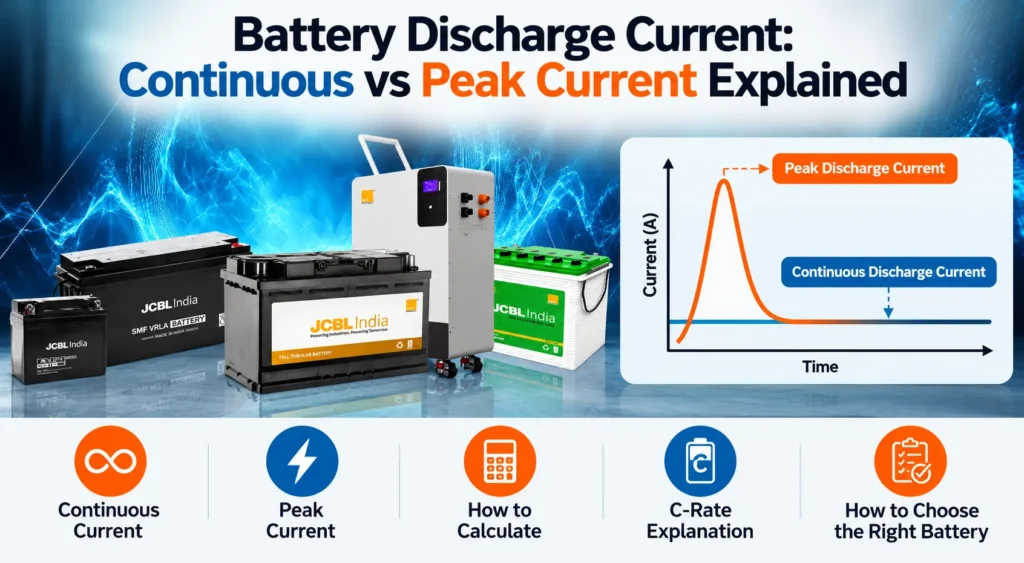
Battery discharge current determines how much electrical current a battery supplies to connected equipment. Continuous discharge current is the current a battery can deliver over a sustained period, while peak discharge current is the higher current it can supply for a limited duration. Understanding both ratings helps OEMs, equipment manufacturers, and battery distributors select batteries that meet load requirements without exceeding specified operating limits.
What Is Battery Discharge Current?
Battery discharge current is the rate at which electrical charge flows from a battery to a connected load, measured in amperes (A). It depends on the equipment’s power demand, operating voltage, and the battery’s discharge capability.
For example, equipment drawing 5 A requires the battery to supply that current during operation. If the equipment briefly draws 15 A during startup, the battery must also accommodate that surge within its rated limits.
What Is Continuous Discharge Current?
Continuous discharge current is the current a battery can supply over a sustained period without exceeding its specified operating limits, provided the manufacturer’s operating and test conditions are met.
It is particularly important for equipment with consistent power demands, such as backup systems and industrial electrical loads.
Key factors that affect continuous discharge capability include:
- Battery design and chemistry: These influence internal resistance, heat generation, and current-delivery capability.
- Operating temperature: Temperatures outside the recommended range may reduce permissible discharge current.
- State of charge: Battery voltage and performance can change as the battery discharges.
- Discharge duration: Sustained current generates heat and may cause voltage to drop under load.
For battery procurement, the continuous discharge rating should meet the application’s normal operating demand under the expected conditions.
What Is Peak Discharge Current?
Peak discharge current is the higher current a battery can supply for a limited period under specified conditions. It accommodates temporary increases in power demand rather than sustained operation.
Peak discharge current may be relevant when:
- Electric motors start and briefly draw additional current.
- Equipment requires a short burst of high power.
- Electrical loads experience temporary surges.
The peak rating must always be evaluated alongside its permitted duration, minimum operating voltage, temperature conditions, and any specified recovery interval.
A high peak current rating does not mean the battery can sustain that current continuously. Exceeding the permitted limit can cause overheating, excessive voltage drop, accelerated degradation, or protective shutdown where protection is fitted.
Continuous vs Peak Discharge Current: Key Differences
| Parameter | Continuous discharge current | Peak discharge current |
| Meaning | Current supplied over a sustained period | Higher current supplied temporarily |
| Duration | Defined by the rating and operating conditions | Limited to a specified duration |
| Typical application | Sustained equipment operation | Startup surges and temporary high loads |
| Main concern | Sustained heating and voltage drop | Short-term electrical and thermal limits |
| Specification to check | Continuous current rating | Peak current and permitted duration |
The primary difference is duration. Continuous current supports ongoing operation, whereas peak current accommodates temporary demand. A suitable battery must meet both requirements when the application needs them.
How to Calculate Battery Discharge Current
For a DC load, discharge current can be estimated using this formula:
Current (A) = Power (W) ÷ Voltage (V)
For example, equipment consuming 120 W from a nominal 12 V DC supply requires an estimated current of:
120 W ÷ 12 V = 10 A
This is an ideal estimate. Actual current may differ because of voltage variation, conversion losses, and the equipment’s operating characteristics.
Practical Example: Selecting a Battery for Continuous and Peak Loads
Suppose an equipment manufacturer specifies a continuous load of 10 A and a startup surge of 20 A for two seconds.
The selected battery should have:
- A continuous discharge rating of at least 10 A under the expected operating conditions.
- A peak discharge rating that supports at least 20 A for two seconds.
- Sufficient voltage stability and thermal capability for the application.
- Any required protection and compliance characteristics specified by the equipment manufacturer.
These are illustrative load requirements, not universal battery ratings. The manufacturer’s datasheet must confirm that the battery can support both demands under the relevant conditions.
What Is Battery C-Rate?
C-rate expresses discharge current relative to a battery’s rated capacity in ampere-hours (Ah).
C-rate = Discharge current (A) ÷ Rated capacity (Ah)
For example, a 10 Ah battery discharging at 5 A operates at 0.5C. At 10 A, it operates at 1C.
C-rate helps compare discharge conditions relative to capacity, but it does not independently establish the maximum safe discharge current. That limit depends on the battery’s design and manufacturer specifications.
How to Choose the Right Battery Discharge Current Rating
For OEMs, equipment manufacturers, and bulk battery buyers, the following checks help establish suitability:
- Calculate normal load demand: Determine the current required during regular operation.
- Identify startup and surge requirements: Establish the maximum current and how long it must be supported.
- Verify both ratings: Compare the continuous and peak requirements with the battery’s specified limits.
- Check operating conditions: Review temperature, minimum operating voltage, duty cycle, and any required derating.
- Review the datasheet: Compare battery models using equivalent test conditions rather than relying on Ah capacity or peak current alone.
For B2B procurement in India and international markets, these checks help buyers evaluate technical suitability across battery models and suppliers. Final selection should follow the application requirements, relevant safety standards, and manufacturer guidance.
Conclusion
Selecting the right battery requires more than comparing capacity ratings. Continuous discharge current determines sustained-load suitability, while peak discharge current determines whether temporary surges can be supported within specified limits. For reliable battery selection, match both ratings to the application’s power demand and verify performance against the manufacturer’s datasheet.
Need help selecting a battery for your application? Contact our technical team to discuss your operating requirements, discharge-current needs, and battery specifications.
FAQs
Neither is universally more important. Continuous current determines whether a battery can support sustained loads, while peak current determines whether it can accommodate temporary surges. Both matter when the application requires them.
Not necessarily. A higher peak rating may benefit applications with substantial startup demands, but selection also depends on continuous current capability, capacity, operating conditions, service life, and application requirements.
Excessive current can cause voltage drop, overheating, accelerated degradation, or protective shutdown if protection is installed. The consequences depend on the battery design, overload severity, and duration.
No. Ampere-hour capacity indicates the charge a battery is rated to deliver under specified conditions. Maximum discharge current depends on factors such as chemistry, internal resistance, construction, and manufacturer-defined limits.
Check the manufacturer’s datasheet for continuous and peak current ratings, peak duration, temperature limits, and minimum operating voltage. If these specifications are unavailable, request clarification from the manufacturer before approving the battery for the application.